

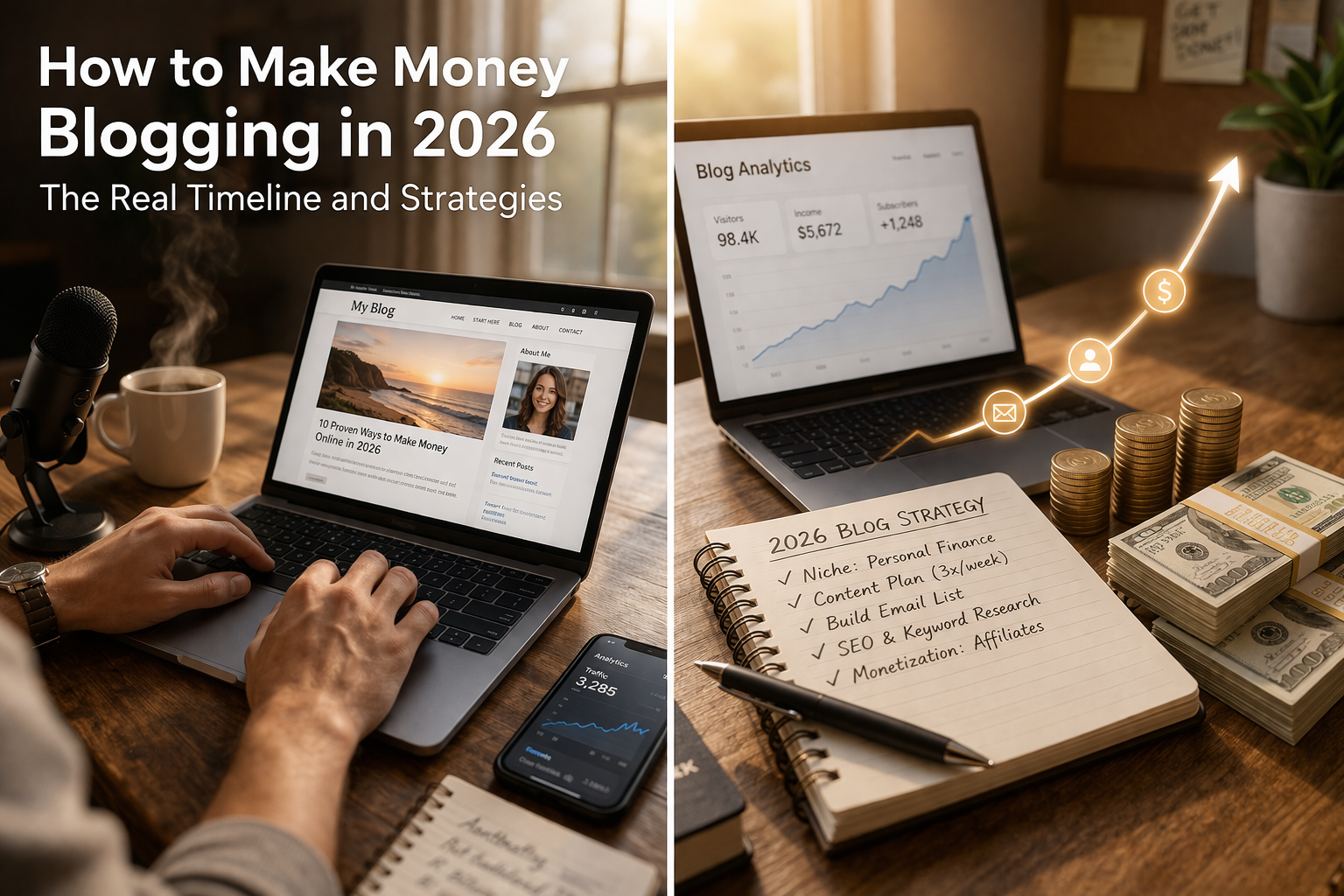
How to Make Money Blogging in 2026
The Real Timeline and Strategies
Blogging is often mentioned as a way to make passive income. The fantasy goes like this: start a blog, write a few posts, optimize for search engines, watch the money roll in passively while you sleep. This fantasy is responsible for millions of abandoned blogs. The reality is harder and better. Yes, you can make real money blogging. Yes, some bloggers make six figures or more annually. But it takes months or years of consistent work before meaningful income appears. It requires understanding your audience better than you understand yourself. It requires writing that actually helps people, not just writing that ranks. It requires choosing a monetization method that matches your audience and content. Most importantly, it requires the discipline to write when no one is reading yet, to improve when you are not seeing results, and to persist through months where your blog generates zero dollars. This guide shows you the real path to blog monetization: not the fantasy, but the actual strategies that work in 2026.
Direct Answer — Featured Snippet
Realistic ways to make money blogging include Google Adsense (passive ads, $500-5000+/month with significant traffic), affiliate marketing (promoting products, $1000-10,000+/month with engaged audience), sponsorships (brands paying to be mentioned, $500-5000+ per post), digital products (courses or ebooks, $500-10,000+/month), and services (using blog to attract clients, $5000+/month). Timeline to first income: 3-6 months minimum with quality content and traffic. Timeline to significant income ($1000+/month): 12-24 months. Success requires choosing a niche you understand, building an audience before focusing on monetization, and selecting income methods aligned with your audience. Most blogs fail to generate any income because they give up before traffic grows.
Why Most Blogs Never Make Money (And How to Be Different)
Millions of blogs are started every month. Millions are abandoned within a year. The reason is simple: the creators expected money quickly and quit when it did not come. They did not understand the actual timeline. They did not know how much work real traction requires. They did not learn that monetization comes last, not first. Building a successful blog is not about discovering some hidden traffic hack. It is about consistently creating content that helps people solve real problems, doing this long enough that search engines notice and recommend it, and then monetizing the audience you have built.
Most blogs fail not because blogging is not viable. Blogging is viable. Thousands of blogs generate meaningful income. But success requires understanding what you are actually doing: you are building an asset, not a quick money machine. You are making an investment of time before you see returns. You are competing against established bloggers in the same space. You are depending on algorithms that can change at any time.
The blogs that succeed are those run by people who understand these realities and do it anyway. They start without expecting immediate income. They write with the assumption they might not make money for a year. They focus on quality and helping people, trusting that income will follow. They persist.
Core Insight
A blog is not a business until it has an audience. Before that, it is a practice ground where you build expertise, write clearly, and learn what people care about. Monetization happens after you have built the audience, never before.
The Actual Timeline to Blog Income (Not the Fantasy)
Most guides will not tell you this. You will read that you can make money « quickly » with a blog. Here is the honest timeline:
Months 1-3: The invisible phase
You are writing. Almost no one is reading. Your posts are ranking nowhere. You are checking analytics obsessively and seeing zeros. You are wondering if this is worth it. This is normal. This is where most people quit.
Months 4-6: Slow traction begins
A few posts are starting to rank. You are getting maybe 50-200 monthly visitors. It is still nothing but at least it is something. You can see that writing helpful content works. This is encouraging but the income is still zero.
Months 7-12: Momentum builds
You now have 500-2000 monthly visitors. Traffic is growing but inconsistently. A few posts are actually ranking decently. You might get your first affiliate commission or Adsense click. The amounts are laughable (a few dollars) but proof that monetization is possible.
Month 12-18: Real income appears
You now have 3000-10,000 monthly visitors. Affiliate commissions are actually adding up. Adsense is generating maybe $50-200/month. You have probably gotten first sponsorship inquiries or are considering a digital product. The income is still modest but it is real.
Month 18-24: Significant income possible
If you have picked a profitable niche and built a loyal audience, you might be making $1000+/month from a combination of Adsense, affiliate, and sponsorships. Digital products might be generating additional revenue.
Month 24+: Scaling phase
If your blog is successful, you are now focusing on scaling: selling services, creating premium content, building a larger email list, launching bigger digital products. Income might be $5000+/month or more.
Choosing Your Niche: Profit-Focused Vs Passion-Focused
Your niche determines your income potential. Some niches are inherently more profitable than others. Understanding this helps you make conscious trade-offs:
High-profit niches (harder audience, higher monetization)
Personal finance, investing, business, technology, health, productivity, real estate. These audiences have money and are willing to spend. Adsense pays more. Affiliate commissions are higher. Sponsorships pay well. But competition is extreme. Ranking is harder.
Medium-profit niches (easier audience, moderate monetization)
Travel, cooking, fitness, hobbies, relationships. These have reasonable monetization and passionate audiences. Competition is lower than high-profit niches but still present. Ranking is more achievable.
Low-profit niches (engaged audience, difficult monetization)
Creative writing, poetry, personal essays, niche communities. These have passionate engaged audiences but monetization is hard. Adsense pays little. Affiliate options are limited. You monetize through services or digital products, not passive methods.
The classic advice is « blog about your passion. » Better advice is « blog about something you care about that enough people care about to generate income. » The intersection of your interest and audience demand is where success lives.
The Best Monetization Methods Explained
Monetization Strategies Covered
Method 1 — Google Adsense: The Passive Income Dream
Google Adsense puts ads on your blog. You earn when people view ads or click them. It is the most passive monetization method. You do nothing except write good content and let Google handle the ads. Income is automatic. But the income is usually modest: $1-10 per 1000 page views (CPM varies by niche, traffic source, and season). So you need significant traffic to make meaningful money.
Adsense’s strength is passivity and ease. No selling required. Approval is usually quick. Income starts flowing as soon as you have traffic. The weakness is that income is modest relative to traffic required. You need 100,000+ monthly visitors to make $1000/month with Adsense. Also, Adsense does not align incentive with reader benefit. The ads interrupt reading. Some readers hate ads.
No setup. Automatic ad placement. Pay per view/click. Income: $1-10 per 1000 views. Requires significant traffic (100k+ monthly for $1000/month). Passive but modest.
Best for: blogs with large audiences, supplemental income, writers not interested in selling
Method 2 — Affiliate Marketing: Promote Products, Earn Commissions
Recommend products relevant to your audience. Include affiliate links. Earn commission on sales. This is more lucrative than Adsense but requires genuine recommendations. Commissions vary: 2-10% for typical products, 20-50% for digital products. You earn only when people buy, but the commissions are significant enough that sales justify the effort.
Affiliate marketing’s strength is that commissions often exceed Adsense significantly. $100 in affiliate sales might earn $20, compared to $2-5 from the same traffic on Adsense. The weakness is that it requires trust. Your audience needs to trust your recommendations. Also, finding good affiliate products requires research. Also, quality is important. Recommending bad products damages credibility.
Networks: Amazon Associates, Shareasale, Impact, CJ Affiliate. Commission: 2-50% depending on product. Income: $200-5000+/month with engaged audience. Requires trust.
Best for: blogs in business, tech, tools, travel, products with clear recommendations
Method 3 — Sponsorships: Brands Pay for Mentions
Brands pay you to mention their products. A coffee brand pays to be mentioned in your productivity blog. A travel company pays for a mention in your travel blog. You write naturally about the product, include disclosure, and get paid. Sponsorships typically pay $500-5000+ per post depending on audience size and engagement.
Sponsorships’ strength is the significant per-post income and the relatively small audience required (10,000 engaged monthly readers can attract sponsorship interest). The weakness is that you need relationships with brands, which take time to develop. Also, you need to maintain editorial integrity—sponsoring bad products damages credibility.
Brands contact you directly or through networks. Payment: $500-5000+ per post depending on audience. Requires engaged audience (10k+) and good fit with brands.
Best for: blogs with engaged audiences, clear audience demographics, niches with brand interest
Method 4 — Digital Products: Courses, Ebooks, Templates
Create and sell digital products: courses teaching your expertise, ebooks with detailed guides, templates people can use. You do the work once, sell repeatedly. It is the closest thing to true passive income. A course might sell for $27-497. Ebooks typically $7-37. Templates $5-27. With an engaged audience, you can earn significant income from products.
Digital products’ strength is that they are truly passive once created and margins are 100%. A course sells for $97, you keep the entire $97. The weakness is that creating quality products is hard work. Also, you need an audience to sell to. A digital product with no audience generates zero income. Also, product quality matters—bad products get refunds and damage credibility.
Platforms: Gumroad, Teachable, SendOwl. Pricing: $7-497 depending on product. Income: $500-10,000+/month with audience. Requires 4-8 weeks of creation work.
Best for: blogs with engaged, loyal audiences, creators with expertise
Method 5 — Services: Use Blog to Attract Clients
Use your blog to demonstrate expertise and attract paying clients. A writing blog might attract freelance writing clients. A design blog might attract design clients. A business blog might attract consulting clients. You do not sell anything directly on the blog. The blog is the sales funnel. Income is direct payment for services: $50-500/hour or $2000-10,000+ per project.
Services’ strength is that high-value clients are attracted to demonstrable expertise. A blog position you as expert, attracting premium clients. The weakness is that it is time-based income. You are limited by hours available. Also, you need to be willing to sell your services directly.
No platform needed. Clients contact you directly. Rate: $50-500/hour or $2000-10,000+ per project. Income: $5000+/month but requires client availability.
Best for: blogs in professional services, consulting, freelancing, high-skill areas
Method 6 — Membership: Paid Community or Premium Content
Create a paid community or premium content area. Members pay monthly for access. Membership creates recurring income and deepens audience engagement. Pricing typically $5-50/month. With an engaged community, you can earn significant recurring income. A 1000-member community at $20/month is $20,000/month.
Membership’s strength is recurring income and community building. The weakness is that it requires an audience already convinced they should pay you. Also, you need to provide consistent value to justify the cost. Also, friction increases—not everyone will pay even if interested.
Platforms: Patreon, Circle, MemberPress. Pricing: $5-50/month. Income: $500-50,000+/month depending on community size. Requires existing engaged audience.
Best for: blogs with extremely engaged audiences, communities, newsletters with loyal followers
Quick Reference Table: Monetization Methods Compared
| Method | Effort to Setup | Traffic Required | Potential Income | Passive Level |
|---|---|---|---|---|
| Google Adsense | Minimal | 100k+ monthly | $1000+ | Very High |
| Affiliate Marketing | Moderate | 10k monthly | $1000-5000+ | High |
| Sponsorships | Moderate | 10k+ monthly | $500-5000+/post | Medium |
| Digital Products | High | 5k engaged | $1000-10,000+ | Very High |
| Services | Moderate | 2k qualified | $5000+ | Low (time-based) |
| Membership | Moderate | 1k+ engaged | $500-50,000+ | High (recurring) |
The Real Strategy: Build Audience First, Monetize Second
This is the mistake most new bloggers make: they start with monetization in mind. They set up Adsense before they have traffic. They write about what is « profitable » rather than what they know. They are thinking about money before they have an audience to make money from.
The winning strategy is different: focus on audience for 6-12 months. Write content that actually helps people. Build trust. Build an email list. Understand what your audience cares about. Only after you have built audience and trust do you monetize.
This approach seems counterintuitive. Why spend 6-12 months making zero dollars? Because trying to monetize before you have an audience is wasting your time. Monetization on traffic-less blogs generates cents. Monetization on traffic-rich blogs generates dollars. You are building the asset before selling it.
The 12-month audience building roadmap
- Months 1-3: Write 2-3 quality posts weekly. Learn SEO basics. Do not think about monetization.
- Months 4-6: Analyze what is working. Double down on topics getting traction. Start building email list. Still no monetization.
- Months 7-9: Traffic is growing. Begin light monetization: Google Adsense (passive), affiliate links on relevant posts.
- Months 10-12: Establish core audience. Identify high-value topics. Pitch sponsorships. Plan digital products. Serious monetization begins.
Practical Takeaways: Your Blog Launch Strategy
- Choose a niche where you have expertise and there is clear audience demand.
- Expect zero dollars for the first 3-6 months. Plan accordingly.
- Write to help people solve real problems, not to rank or make money.
- Focus on audience building for the first 12 months. Monetization comes after.
- Build an email list from day one. This is your owned audience.
- Start with affiliate marketing and digital products (if you have audience). Skip Adsense alone.
- Combine multiple monetization methods rather than relying on one.
- Do not start a blog expecting to quit your job in 6 months. Plan for 2+ years.
- Track metrics obsessively: traffic, engagement, email list growth, income sources.
- Remember: success comes from persistence through the invisible phase. Most quit there.
Frequently Asked Questions
Can I make money blogging without having a huge audience?
How much does it cost to start a blog?
Do I need to be an expert to start a blog?
How often should I publish?
Can I make money blogging on free platforms like Medium or Substack?
What if my blog never gets traffic?
Should I monetize immediately or wait?
Internal Linking Opportunities for ByteFix Lab
These articles connect naturally with this guide and strengthen your Make Money Online category:
A Deeper Truth: The Blog Economy Rewards Persistence More Than Talent
There is a particular type of person who succeeds at blogging. Not the most talented writer. Not the smartest marketer. Not the luckiest. The person who succeeds is the one who writes a blog post when it will be read by exactly forty-seven people and has made zero dollars so far. Then writes another. Then another. For six months. For a year. Without seeing meaningful results.
Most people cannot do this. Most people need feedback quickly. Most people need validation fast. Most people need income before they invest this much time. So they quit after three months of invisible work and assume blogging does not work.
The blogs that become successful are run by people who started for reasons beyond money. They started because they had something to say and wanted to say it publicly. Or they started to document their learning. Or they started because they liked writing. The money was secondary. And then, as they built audience and trust, the money came.
In the end, the most profitable blogs are those started by people who would blog anyway, even if they never made a dollar.
Everyone else is fighting the wrong battle.