
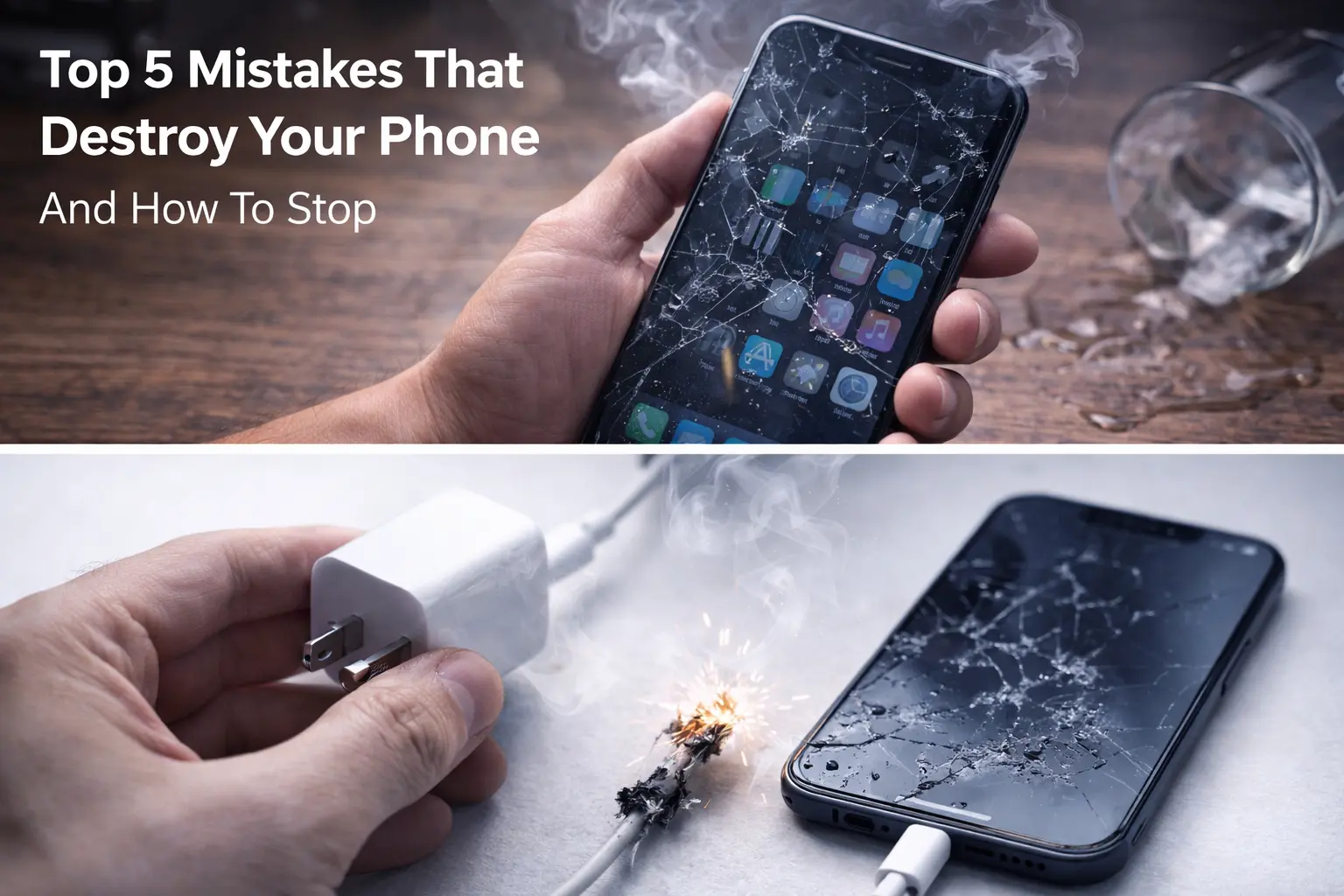
Top 5 Mistakes That Destroy Your Phone
And How To Stop
Smartphones are expensive investments that most people expect to last several years. Yet many phones fail much sooner than they should, not because manufacturers build them poorly, but because users unintentionally damage them through patterns of use that seem harmless at the time. These mistakes compound slowly. A battery weakens month by month. Storage fills gradually. Heat stress accumulates. Performance degrades imperceptibly until one day the phone feels sluggish, holds less charge, or simply stops working reliably. This guide reveals the five biggest mistakes that shorten your phone’s life and shows you exactly how to avoid them.
Direct Answer — Featured Snippet
The five biggest mistakes that destroy smartphones are: ignoring system updates that fix stability and security issues, leaving storage nearly full which prevents proper system operation, running too many background apps that drain battery and degrade performance, exposing the device to extreme heat or moisture that damages internal components, and neglecting battery health which causes rapid capacity loss. Each mistake compounds over months and years. Combined, they can reduce your phone’s usable lifespan by 50 percent or more.
Most Phone Damage Happens Slowly, Invisibly, And Through Patterns That Seem Harmless
A smartphone is an engineering marvel: thousands of components working together inside a case thinner than a pencil, performing feats of computation that would have filled a room in the 1980s. But this complexity creates fragility. The phone depends on systems that must cooperate perfectly. When one pattern of use gradually destabilizes the system, the effects compound invisibly for months before becoming obvious.
This is different from obvious damage like dropping the phone or spilling liquid on it. Those are acute failures. What most people miss are chronic failures—damage that accumulates through daily use patterns. These patterns feel safe because they cause no immediate consequence. You skip an update because the timing is inconvenient. Your storage fills up gradually. You run six apps at once. You leave your phone in a hot car. None of these feel dangerous in the moment. But together, they age your phone years faster than it should.
The frustrating part is that this damage is preventable. Not through special care or paranoia, but through understanding what actually hurts your phone and changing patterns that seem innocent but accumulate into real problems.
Core Insight
Your phone does not fail suddenly most of the time. It fails because patterns of use gradually degrade the systems inside. Understanding which patterns matter most can add years to your device’s useful life.
Why Phones Fail Sooner Than Manufacturers Expect
Smartphone manufacturers design their devices to last years. Modern flagships should reasonably function well for three to five years. Yet many users report problems after two years, or sometimes even one. That discrepancy is not usually the manufacturer’s fault. It is the result of use patterns that the user does not realize are harmful.
Think of a phone like a car. The manufacturer designs it to last 200,000 miles if maintained properly. But if you never change the oil, skip tire rotations, drive aggressively, and park in extreme heat, the car fails much sooner. The manufacturer is not wrong about the car’s potential lifespan. You shortened it through patterns of use.
Phones work the same way. The difference is that phone maintenance is less visible. You do not get an oil change reminder. You do not have to take your phone to a service center. The systems degrade silently until the moment they fail.
The Top 5 Phone Mistakes Covered Here
Mistake 1 — Ignoring System Updates Creates A Cascade of Problems
System updates are not optional. They are not nice-to-haves. They are repairs that manufacturers push out to fix problems they have discovered since the phone shipped. When you skip an update, you are choosing to keep those problems inside your phone, where they compound.
Most users understand that updates fix security vulnerabilities. Fewer understand that updates also fix performance problems, battery drain, stability issues, and compatibility problems with new apps. When an app stops working on your phone but works on others, often the issue is that you are running an older operating system the app no longer supports.
Skipping updates creates technical debt. Each missed update leaves old problems unsolved. Eventually, your phone becomes a patchwork of unfixed issues that collectively make the device less stable, less efficient, and increasingly unreliable.
Do not delay system updates. Security patches matter, but so do stability fixes and performance improvements. Treating updates as something to put off indefinitely is like ignoring car maintenance—the problems compound. Update as soon as the phone notifies you, or at least within a reasonable timeframe.
Real damage: unpatched security vulnerabilities, performance degradation, app incompatibility, battery drain, instability
Mistake 2 — Letting Storage Fill Completely Disables System Functions
Storage is not just a place to store photos and apps. It is where the operating system keeps temporary files, system cache, app data, and working space for core functions. When storage fills to 90 percent or higher, the phone literally runs out of room to function properly.
A phone with nearly full storage exhibits symptoms that users often attribute to aging or hardware failure: apps freeze, the camera app becomes slow or unresponsive, downloads fail, app installations stall, photos cannot be saved, the phone feels sluggish overall. The phone is not broken. It is suffocating. It no longer has the working room it needs to operate.
This is one of the easiest mistakes to fix but also one of the most commonly ignored. Simply cleaning up old files and managing storage properly prevents a cascade of performance problems.
Never let your phone storage fill beyond 80 percent. This means regularly deleting old photos and videos, clearing app caches, removing unused apps, and archiving files to cloud storage. A phone with 30 percent free space operates far better than one with 5 percent free space.
Real damage: performance degradation, app freezes, camera failure, system instability, inability to receive updates
Mistake 3 — Running Too Many Background Apps Drains Battery and Degrades Performance
Modern phones allow dozens of apps to run in the background simultaneously. Users rarely think about this because closing apps is not a visible daily task. But background apps consume battery, use memory, perform data synchronization, and collectively create constant processing overhead that the phone must manage.
A phone with ten apps running in the background is doing far more work than a phone with two background apps. That constant background load reduces battery lifespan, degrades processing performance, creates heat stress, and collectively makes the device feel sluggish. Over time, this pattern significantly shortens battery life because the battery is under constant pressure instead of being used intermittently.
The mistake is not running any background apps—some are essential. The mistake is running too many, allowing all of them to refresh constantly, and never thinking about which background processes you actually need.
Regularly review which apps have background refresh enabled. Disable background refresh for apps you do not need to be constantly active. Manage background app limits. On many phones, you can limit background activity or set specific apps to not refresh at all. This single change can improve battery life by 20 to 30 percent.
Real damage: battery degradation, reduced performance, increased heat generation, reduced device lifespan
Mistake 4 — Exposing the Phone to Heat and Moisture Causes Permanent Component Damage
Smartphones are surprisingly fragile when it comes to heat and moisture. Modern phones are compact, which means internal components are tightly packed. When exposed to high heat, they can literally fail because electronic components have maximum operating temperatures. When exposed to moisture, water can corrode connections and short circuits, causing instant or delayed failure.
The mistake is not a single careless act. It is patterns that seem innocent: leaving your phone in a hot car during summer, using the phone in a steamy bathroom, carrying it in a pocket where body heat accumulates, or placing it on a sunny windowsill. None of these feels dangerous in the moment. But repeated heat exposure degrades battery capacity, can damage the processor and memory, and creates interior corrosion that leads to failures.
Similarly, moisture exposure—even brief—can cause hidden damage. Water inside the phone can corrode connections invisibly, causing failures weeks or months later.
Never leave your phone in direct sunlight for extended periods. Avoid using it in high-temperature environments like saunas, hot cars, or over ovens. Keep it away from moisture in bathrooms and poolside. If your phone does get wet, dry it immediately and avoid charging it until you are certain it is completely dry. Heat over time damages the battery irreversibly. Moisture can cause hidden corrosion.
Real damage: battery capacity loss, processor damage, memory failure, hidden corrosion, delayed component failures
Mistake 5 — Ignoring Battery Health Until Capacity Collapses Suddenly
Smartphone batteries degrade with every charge cycle. This is physics, not failure. After a few hundred cycles, a battery holds less charge. After a thousand cycles, it holds significantly less. The mistake is not using your phone—it is not monitoring battery health and adapting your charging patterns as the battery ages.
Many users notice their phone battery drains faster one day and assume the battery is suddenly bad. In reality, the battery has been degrading gradually for months, and they simply never checked. By the time the decline becomes obvious, the battery is often severely degraded.
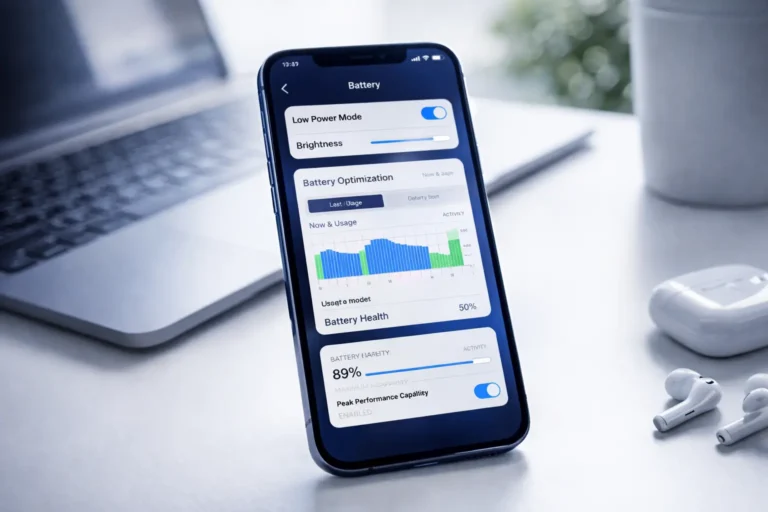
Modern phones have a battery health feature that shows the current capacity of your battery compared to when it was new. Checking this occasionally tells you how your battery is aging. If capacity drops below 80 percent, your battery is aging faster than normal. If it drops below 70 percent, the battery has become significantly degraded. Knowing this helps you decide whether to replace the battery before it becomes completely unreliable.
On iPhone, go to Settings > Battery > Battery Health. On Android, look for battery health information in settings (varies by manufacturer). Check this every few months. If capacity drops below 80 percent, consider replacing the battery. Do not wait until capacity reaches 50 percent and the phone becomes unusable.
Real damage: reduced runtime, phone shuts down at high battery percentage, eventual complete capacity loss
Quick Reference: The Five Mistakes and Their Consequences
| The Mistake | What Happens | How to Prevent It |
|---|---|---|
| Skipping system updates | Security vulnerabilities, performance issues, app incompatibility, stability problems | Update as soon as notification appears, within two weeks at maximum |
| Letting storage fill completely | App freezes, camera slowness, download failures, overall sluggishness | Delete old files, clear cache, keep at least 15-20% free space |
| Running too many background apps | Battery drain, performance degradation, heat generation, reduced lifespan | Disable background refresh for non-essential apps, limit background processes |
| Exposing phone to heat and moisture | Battery damage, processor failure, corrosion, hidden failures | Avoid hot environments, keep away from moisture, use protective case |
| Ignoring battery health | Reduced runtime, poor battery performance, eventual capacity collapse | Check battery health monthly, replace before dropping below 70% |
How Mistakes Compound: Why Prevention Is Easier Than Repair
The dangerous part about these five mistakes is that they compound. A user might skip updates AND let storage fill AND run many background apps simultaneously. Each mistake makes the phone less stable. Together, they create a device that feels like it is aging rapidly.
Once the phone has sustained multiple forms of damage, recovery becomes difficult. Storage cannot be quickly freed if the phone is already sluggish. Updates cannot be installed smoothly on a phone with barely any free space. Battery health cannot be recovered—it only degradation. The damage, once accumulated, is largely irreversible.
This is why prevention is so much more effective than trying to fix problems after they develop. Preventing storage from filling is easy. Fixing a phone that refuses to function because storage is full is much harder.
Common Misconceptions About Phone Damage
Misconception: My phone is still under warranty, so damage does not matter
Warranty does not cover damage from use patterns. If your phone fails because you ignored updates or let storage fill completely, the warranty will not cover it. Warranty covers manufacturing defects, not self-inflicted damage through negligent use.
Misconception: Newer phones are more fragile than older phones
Newer phones are more durable in hardware but more sensitive to software issues. An older phone might tolerate outdated software better because it ran on simpler systems. Modern phones depend on updated systems to function properly. Skipping updates on a new phone creates more problems than skipping updates on an older phone.
Misconception: My phone has not had problems yet, so these mistakes do not apply to me
Damage compounds invisibly. You do not see battery degradation until it becomes severe. You do not see storage filling until the phone suddenly sluggish. You do not see security vulnerabilities until they are exploited. Waiting for obvious symptoms is waiting until the damage is advanced.
Misconception: Turning the phone off occasionally resets all the problems
A restart helps with temporary issues but does not repair underlying damage. Storage does not magically free itself. Battery capacity does not restore. Updates do not install themselves. The damage compounds regardless of how often you restart.
Practical Maintenance Schedule: Prevention Steps by Time Interval
Daily or Weekly
- Keep phone away from direct heat or moisture exposure
- Check for any new system update notifications
- Notice if phone performance has changed unexpectedly
Monthly
- Check battery health status in settings
- Review storage usage and delete unnecessary files
- Check which apps are running in the background
- Disable background refresh for apps you do not need constantly active
Quarterly
- Clear app caches to free storage space
- Review which apps you actually use, delete unused ones
- Check for system update history—confirm you are not behind multiple updates
- Review battery health trend—is capacity dropping faster than normal?
Annually
- Deep storage cleanup—archive photos and videos to cloud, delete duplicates
- Factory reset if your phone feels significantly slower (as last resort)
- Consider battery replacement if capacity has dropped below 80%
- Compare phone performance to baseline from one year prior
Practical Takeaways: Prevention Actions You Can Take Right Now
- Install any pending system updates today, do not delay them.
- Check your storage usage right now and delete unnecessary files if needed.
- Open your settings and disable background app refresh for apps you do not need constant access to.
- Check your battery health and note the current capacity percentage.
- Commit to never leaving your phone in direct heat or moisture exposure.
- Set a monthly reminder to check storage and battery health.
- Create a maintenance habit—five minutes per month prevents serious problems.
- If battery capacity has dropped below 80%, plan to replace the battery soon.
- Treat your phone like you treat your car—preventive maintenance is cheaper than repairs.
- Remember: most phone damage is preventable through awareness and simple actions.
Frequently Asked Questions
If I have already made these mistakes, is the damage permanent?
How often should I replace my phone if I maintain it properly?
Does leaving my phone plugged in overnight cause battery damage?
Is it better to use low power mode all the time to preserve battery?
Can I fix a phone that has suffered heat or water damage?
What is a normal battery capacity percentage after one year?
Do I need to completely uninstall apps I do not use?
Internal Linking Opportunities for ByteFix Lab
These three articles connect naturally with this guide and strengthen your Device Maintenance category:
A Deeper Truth: Why We Damage Our Phones Without Realizing It
Smartphones occupy a strange place in our relationship with technology. We treat them casually—carrying them everywhere, using them constantly, upgrading often. Yet they are precision devices that age according to specific patterns. The damage happens because we do not see the consequences of our actions in real time.
If you burned your hand on a hot surface, you would feel it immediately and avoid it in the future. But if heat slowly degraded your phone’s battery, you would not feel anything until the battery was already severely damaged. The lack of immediate feedback makes it easy to repeat damaging patterns.
This is why the most important thing is not being paranoid about your phone. It is being aware. It is understanding which patterns actually matter. It is checking on your device occasionally instead of ignoring it until something breaks.
In the end, your phone does not fail because you are careless.
It fails because you were unaware that the patterns you thought were harmless were slowly compounding into serious damage.