

Best Platforms to Sell Your Skills Online
Where Real Clients Actually Pay
Everyone says the internet is full of opportunity. That part is true. What they usually forget to mention is that opportunity is scattered, competitive, and unevenly distributed. You can absolutely make money online by selling your skills, but success depends less on luck and more on one hard question: are you standing in the right marketplace? A talented person on the wrong platform struggles for months. A moderately skilled person on the right platform, with a clear offer and solid positioning, can find clients surprisingly fast. This guide breaks down the best platforms to sell your skills online in 2026, how each one really works, who it is best for, how much you can realistically expect, and why choosing the right platform matters more than endlessly polishing your portfolio in private.
Direct Answer — Featured Snippet
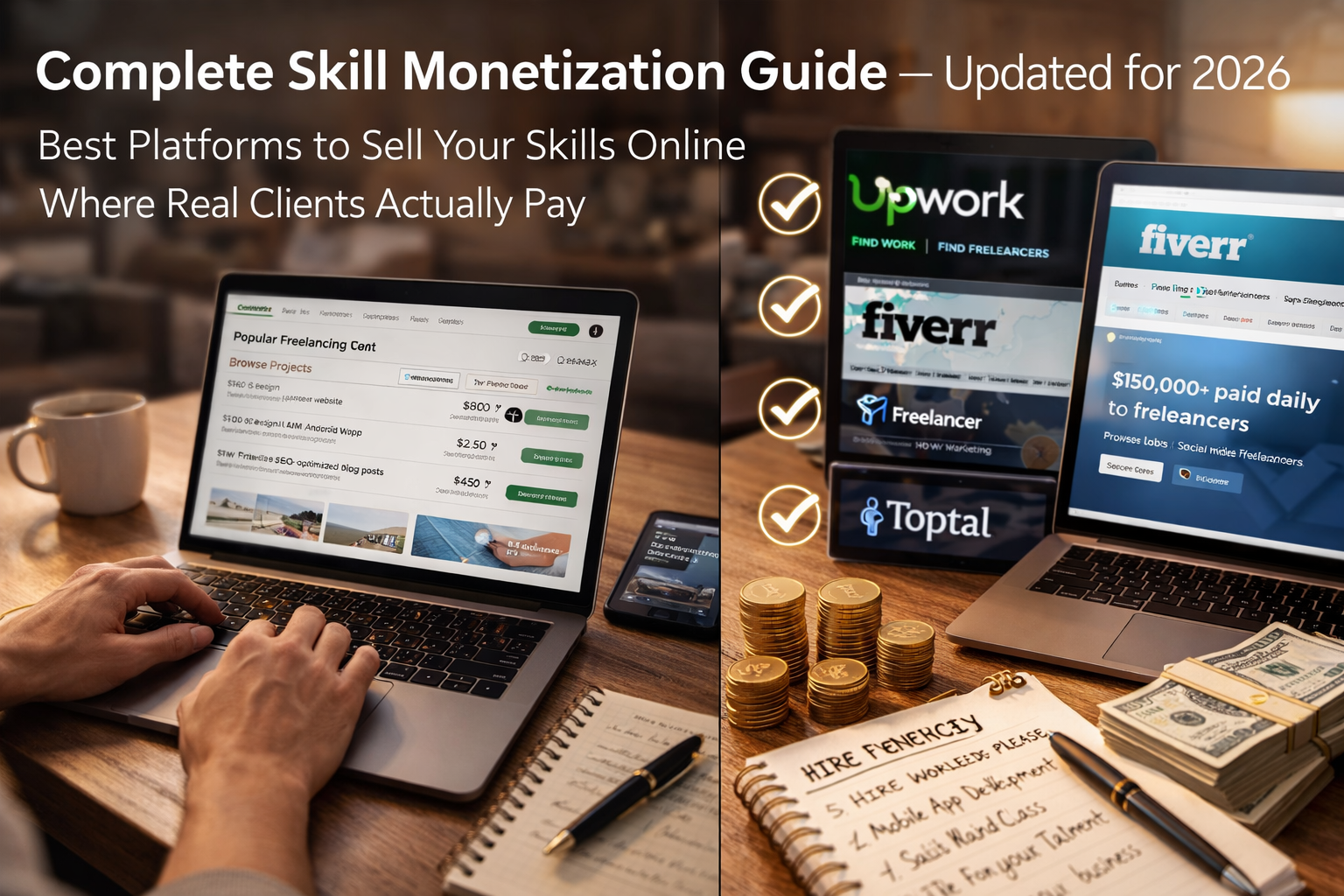
The best platforms to sell your skills online depend on the type of work you offer. Upwork is strong for professional freelance services, Fiverr works well for packaged offers and fast visibility, LinkedIn is powerful for consultants and B2B experts, Etsy is ideal for digital creatives selling templates or design assets, Gumroad is excellent for digital products, Preply and similar tutoring marketplaces fit teachers and language experts, and Contra appeals to modern freelancers who want a cleaner professional profile. The best strategy is not joining every platform. It is choosing one or two that match your service type, target clients, pricing style, and communication strength.
Why Most Skilled People Still Struggle to Make Money Online
Skill alone is not enough. This is one of the hardest truths for smart, capable people to accept. You can be an excellent writer, designer, translator, editor, developer, teacher, marketer, or consultant and still fail to earn online for a simple reason: the market cannot understand your value fast enough. Online platforms are crowded. Buyers do not spend ten minutes admiring your hidden talent. They scan quickly, compare fast, and choose whoever looks clear, useful, and low-risk.
That means your real competition is not just other experts. It is clarity. It is positioning. It is trust. It is whether a stranger can land on your profile and immediately understand what problem you solve, for whom, and why they should believe you. Many freelancers spend too much time improving the work and too little time improving the offer. They say, “I can do many things.” Buyers hear, “I do not specialize.” They say, “I am passionate and hardworking.” Buyers hear nothing concrete. The platform becomes crowded not because there are too many good people, but because there are too many vague profiles.
The right platform helps solve part of this problem. Some marketplaces are built for fixed services. Others are built for long-term contracts. Some favor quick decisions. Others reward authority and networking. When your selling style fits the platform’s buying behavior, everything becomes easier.
Core Insight
The internet does not automatically reward skill. It rewards skill that is packaged, placed, and presented where the right buyer is already looking.
How to Choose the Right Platform Before You Waste Time
Before looking at platform names, understand the four questions that matter most. First, are you selling a service, a session, or a product? Writing a blog post is a service. Teaching a one-hour lesson is a session. Selling a Notion template is a product. Each format works best on different marketplaces.
Second, are your buyers individuals or businesses? Individual buyers often prefer fast, visible, lower-risk marketplaces with simple pricing. Business buyers may care more about professionalism, case studies, communication, and long-term reliability. A corporate client looking for a ghostwriter behaves very differently from someone buying a logo for a side hustle.
Third, do you prefer custom quotes or fixed offers? Some freelancers are better in conversations and discovery calls. Others perform better when their services are packaged into clear tiers with fast checkout. Fixed packages reduce friction. Custom proposals allow higher pricing. Neither is always better. It depends on your work.
Fourth, do you want client work only, or do you also want scalable income? Client work pays faster. Digital products scale better. Many people should do both. For example, a designer may sell templates while also taking custom clients. A teacher may offer tutoring while selling study guides. A writer may freelance while building ebooks or mini courses.
The Best Platforms to Sell Your Skills Online
Platform 1 — Upwork: Best for Professional Freelancers
Upwork is one of the most obvious names in freelancing, and for good reason. It remains one of the strongest places for professionals who sell writing, design, marketing, admin support, translation, development, consulting, video editing, and other service-based work. The biggest advantage of Upwork is buyer intent. Clients come there looking to hire. They are not casually browsing inspiration. They want a solution now. That matters.
But Upwork is not easy money. New freelancers often arrive, see hundreds of competing proposals, and panic. They assume they must lower prices, apply to everything, and write robotic cover letters. That is usually the wrong approach. Upwork rewards relevance more than volume. A specialist with a focused profile often beats a generalist with broader skills. A translator specializing in French academic texts can outperform someone who “translates everything.” A copywriter for SaaS landing pages can stand out faster than a generic “content writer.”
The platform works best when your profile is built like a buyer-facing sales page. The title must be specific. The opening lines must show clear outcomes. The portfolio must prove the exact kind of work you want more of. Once you start getting reviews, momentum becomes easier. Before that, the beginning can feel slow.
Best for writers, developers, marketers, translators, designers, editors, consultants, and remote professionals who want serious client work and recurring projects.
Best for: experts who can write tailored proposals and want higher-value contracts
Platform 2 — Fiverr: Best for Packaged Services and Fast Entry
Fiverr is often misunderstood. People think it is only for cheap work. That was closer to the truth years ago, but serious sellers now use it in a smarter way. Fiverr is built around productized services. Instead of waiting for a client to describe a project from scratch, you create a service package with a title, description, pricing tiers, delivery time, and optional upgrades. This creates speed. Buyers can understand what you do in seconds.
This model is perfect for skills that can be clearly packaged. Logo design, article writing, proofreading, voice-over, social media graphics, video editing, resume writing, translation, thumbnail design, ebook formatting, and even AI-assisted workflow setup can work well here. The key is specificity. “I will write content” is weak. “I will proofread and polish your French academic essay” is stronger. “I will design a minimalist logo” is still broad. “I will create a modern logo for beauty, tech, or education brands” is tighter.
Fiverr’s strength is discoverability through listings. You do not always need to pitch manually. Clients can find you through search. The weakness is that competition is intense, and thumbnails, titles, reviews, and response time matter a lot. The platform rewards sellers who treat their gigs like storefront pages, not lazy placeholders.
You sell fixed offers with defined pricing, timelines, and deliverables. Buyers can purchase quickly without a long pre-sales conversation.
Best for: creatives, editors, writers, designers, voice artists, and specialists with repeatable offers
Platform 3 — LinkedIn: Best for Consultants, Experts, and B2B Services
LinkedIn is not a freelance marketplace in the traditional sense, but for many professionals it is more powerful than one. That is because LinkedIn functions as a trust engine. If your work depends on authority, thought leadership, referrals, industry credibility, or premium positioning, LinkedIn can outperform platforms that compete mainly on price and speed.
This is especially true for consultants, coaches, trainers, recruiters, B2B copywriters, ghostwriters, branding strategists, curriculum specialists, business translators, and specialized service providers. On LinkedIn, content itself becomes part of the sales process. Your posts, profile, featured section, recommendations, and network all support your credibility. A strong profile can attract inbound leads even when you are not actively pitching.
The weakness is that LinkedIn usually moves slower. Buyers may observe you before contacting you. They may need repeated exposure before they trust you. But when it works, the quality of clients can be much higher. LinkedIn often rewards reputation over hustle. That can be a major advantage for experts who do not want to live inside low-price marketplaces forever.
Less about quick gigs, more about credibility, referrals, networking, consulting leads, and business clients who want expertise they can trust.
Best for: consultants, B2B freelancers, trainers, coaches, educators, and strategic service providers
Platform 4 — Contra: Best for Modern Freelancers Who Want a Cleaner Brand
Contra has attracted attention because it feels more modern, more portfolio-driven, and often more freelancer-friendly in how professionals present themselves. It appeals especially to designers, creators, marketers, developers, brand strategists, and digital specialists who want a sleek online presence combined with freelance discovery.
One reason people like Contra is that it feels closer to a professional identity platform than an old-style job board. That matters because many freelancers are no longer trying only to “get gigs.” They are trying to build a recognizable personal brand. They want a polished public profile, selected services, testimonials, and a presentation that looks premium.
Contra can be useful if you already have some experience and want a cleaner way to showcase it. It may not always produce the same volume of opportunities as giant marketplaces, but it can fit freelancers who care about positioning, aesthetics, and direct professional appeal.
Strong visual presentation, creator-friendly branding, and a good fit for modern digital freelancers who want to look established from day one.
Best for: designers, strategists, marketers, creatives, and freelancers building a premium image
Platform 5 — Gumroad: Best for Turning Skills Into Digital Products
Not every skill should be sold only hour by hour. Some skills can be turned into assets. That is where Gumroad becomes interesting. Instead of selling your time directly, you sell templates, guides, ebooks, toolkits, prompts, swipe files, workshops, mini courses, lesson plans, study resources, design assets, digital downloads, and other knowledge-based products.
This matters because product income scales in a way client work does not. If you are a teacher, you can sell lesson packs. If you are a writer, you can sell writing templates or research bundles. If you are a designer, you can sell brand kits or social media templates. If you are a consultant, you can sell audits, playbooks, or frameworks. Gumroad is attractive because it lowers the barrier between expertise and monetization.
The challenge is that products rarely sell themselves. You still need audience, discovery, or distribution. Gumroad works best when combined with another platform such as LinkedIn, X, YouTube, a blog, an email list, or even Fiverr. In other words, Gumroad is a strong checkout and product layer, but it is often not the entire growth engine by itself.
Great for templates, guides, ebooks, downloads, educational resources, and frameworks that can be sold repeatedly without custom delivery each time.
Best for: educators, writers, designers, creators, consultants, and knowledge workers
Platform 6 — Etsy: Best for Creatives Selling Digital Assets
Many people still think of Etsy mainly as a place for handmade physical goods. That overlooks one of its strongest opportunities: digital products. Printable planners, wall art, invitation templates, educational worksheets, resume templates, business forms, social media bundles, journal pages, and niche design downloads can perform very well there.
Etsy is especially useful for creative people whose skills can be converted into ready-to-buy assets. The customer journey is usually simpler than in custom service marketplaces. The buyer wants an item, sees the preview, checks reviews, and purchases. This can reduce the emotional exhaustion of pitching clients all day.
That said, Etsy is a search-driven platform. Titles, mockups, keywords, product previews, and niche selection matter enormously. It favors people who can think not only like creators but also like merchants. The strongest shops usually solve a very specific use case rather than uploading random designs without a strategy.
Better for product sellers than service providers. Works well when your skill can become a visual asset people can buy immediately.
Best for: template creators, printable designers, digital planners, educational downloads, and niche visual products
Platform 7 — Preply and Other Tutoring Marketplaces: Best for Teachers and Language Experts
If your skill is teaching, tutoring, coaching, language instruction, or academic support, general freelance marketplaces are not always your best option. Specialized tutoring platforms can make client acquisition easier because the buyer already understands the format. They are not looking for a vague “service.” They are looking for lessons, improvement, consistency, and outcomes.
This is especially relevant for language teachers, exam coaches, conversation tutors, writing instructors, subject tutors, and educators with a structured teaching process. On a tutoring platform, your profile must communicate results, student level, lesson style, and personality. Trust matters, but so do professionalism and clarity. Students often choose a teacher based on who feels understandable, patient, and credible.
These platforms also offer something emotionally valuable: a simpler sales process. Many educators are excellent at teaching but uncomfortable with aggressive self-promotion. A tutoring marketplace gives them a more natural environment where expertise and teaching style are already central to the decision.
Specialized marketplaces can help teachers sell sessions more naturally than general freelance sites where lessons may feel harder to position.
Best for: language teachers, subject tutors, writing coaches, academic support professionals, and educators
Quick Comparison Table: Which Platform Fits Which Skill?
| Platform | Best For | Selling Style | Income Model | Difficulty Level |
|---|---|---|---|---|
| Upwork | Professional services | Custom proposals | Projects / long-term clients | Medium to High |
| Fiverr | Packaged freelance offers | Fixed gigs | One-off and repeat orders | Medium |
| Consulting and B2B expertise | Authority + networking | Premium clients | Medium to High | |
| Contra | Modern independent freelancers | Portfolio-driven | Direct projects | Medium |
| Gumroad | Digital products | Product storefront | Scalable downloads | Medium |
| Etsy | Creative digital assets | Search-based listings | Product sales | Medium |
| Preply / tutoring platforms | Teaching and lessons | Session booking | Hourly teaching income | Low to Medium |
The Smartest Strategy Is Usually Hybrid, Not Single-Platform
Many people ask, “Which one platform is best?” That sounds efficient, but it is often the wrong question. The stronger question is, “Which combination creates stability?” For example, a freelance writer might use Upwork for recurring client work, LinkedIn for authority, and Gumroad for guides or templates. A language teacher might use a tutoring marketplace for sessions and Gumroad for study packs. A designer might use Fiverr for fast packages, Contra for brand presence, and Etsy for templates.
This hybrid approach protects you from platform dependency. Relying on only one marketplace can be risky. Rankings change. fees change. algorithms change. competition shifts. If one platform slows down, a second income path helps you stay stable.
But hybrid does not mean chaotic. Build one channel first. Make it work. Then layer another. The goal is resilience, not distraction.
Practical Strategy
Start with one platform for cash flow and one asset for long-term control. Cash flow could be Upwork, Fiverr, or tutoring. Long-term control could be LinkedIn, an email list, a personal site, or digital products.
What Makes a Profile Convert Better on Any Platform
The platform matters, but profile fundamentals matter everywhere. First, specificity wins. Name the exact service and exact audience. Second, outcomes beat adjectives. “I help coaches turn rough ideas into polished ebooks” is stronger than “I am creative and dedicated.” Third, proof reduces risk. Reviews, samples, case studies, screenshots, before-and-after examples, and real results matter. Fourth, friction kills conversions. Make your process easy to understand. State what the buyer gets, when they get it, and what happens next.
Communication also matters more than many freelancers realize. Fast responses, professional tone, and clear expectations often separate sellers who keep clients from those who keep restarting. The internet contains many skilled people. Reliability is still rarer than talent.
- Use a clear title that names your skill and niche.
- Open with the client’s problem, not your biography.
- Show samples that match the exact work you want more of.
- Package services in a way that removes confusion.
- Respond quickly and write like a professional, not a hobbyist.
- Ask for reviews after successful projects.
- Raise prices only after your positioning and proof improve.
- Do not copy generic profiles from other freelancers.
- Specialization usually increases trust faster than broadness.
- Treat every platform as a storefront, not a placeholder.
Frequently Asked Questions
Which platform is best for beginners with no reviews?
Should I choose freelancing or digital products?
Can I use more than one platform at the same time?
What if my skill is teaching French or academic writing?
How long does it take to get the first client?
Is competition too high in 2026?
Should I create my own website too?
Internal Linking Opportunities for ByteFix Lab
These articles connect naturally with this guide and strengthen your Make Money Online category:
A Deeper Truth: The Internet Rewards People Who Learn to Package Their Value
There is a quiet frustration many skilled people carry for years. They know they are capable. They know their work is good. They know they can help people. Yet the money stays inconsistent, the opportunities stay random, and the market feels strangely indifferent. Over time, they start doubting the skill itself.
But the problem is often not the skill. The problem is translation. The internet is a giant sorting machine. It sorts offers, signals, images, words, trust markers, and pricing cues at absurd speed. It does not pause to appreciate hidden depth. It responds to what is visible, understandable, and credible in the moment.
This is why some people with moderate skill win faster than more talented peers. They learned to translate their value into something the market can understand. They chose the right platform. They named the right problem. They showed the right proof. They removed doubt. And once trust appears, opportunity often compounds.
In the end, the people who earn online are not always the most gifted.
Very often, they are the ones who learned how to be clearly useful in public.