
Slow Phone?
Boost Speed in 5 Minutes
A slow phone feels older than it really is. Apps hesitate, scrolling drags, typing lags, and everything becomes just annoying enough to ruin the experience. The good news is that most phones do not become slow for one mysterious reason. They become slow through a pattern of overload, and that pattern can be reversed faster than most people think.
Direct Answer — Featured Snippet
If your phone is slow, the most common causes are overloaded storage, too many background apps, excessive cache data, overheating, outdated software, and heavy visual effects. The fastest way to improve speed is to restart the device, free up storage, close unnecessary background activity, update the system, and reduce resource-heavy features. In many cases, noticeable improvement happens in less than five minutes.
Why a Slow Phone Feels More Frustrating Than a Broken One
A broken phone gives you a clear story. Something failed. Something stopped. The problem is visible. A slow phone is different. It works just enough to keep you using it, but badly enough to make every action feel heavier. You tap an app and it opens late. You type and the keyboard appears half a second behind your thoughts. You scroll and the motion feels sticky instead of fluid. Nothing is fully broken, yet the whole experience becomes quietly exhausting.
That is why users often describe slowness in emotional terms before technical ones. They say the phone feels tired, old, weak, overloaded, or “not like before.” Those descriptions matter because they reveal something important: performance is not only about speed benchmarks. It is about responsiveness, rhythm, and trust. When a phone slows down, what disappears is not simply milliseconds. It is confidence.
The mistake many people make at this stage is assuming age is the whole story. “My phone is just old.” Sometimes that is partly true. But very often the device is not fundamentally weak. It is simply burdened — by storage pressure, background activity, thermal stress, unfinished updates, bloated apps, or the accumulation of months of digital clutter.
Core Insight
Most slow phones are not dying. They are congested. That means the problem is often not permanent, and the fix is usually more about reducing pressure than adding more software.
What People Really Mean When They Search “Slow Phone”
On the surface, this is an informational query. In reality, it is a practical rescue query. The user is asking several urgent questions at once: Why is my phone slow now? Can I fix it without paying? Do I need a new phone? And is there something simple I can do immediately?
That means the best article on this subject cannot just offer generic performance advice. It has to do three things at the same time. First, it must explain the real causes behind slowness in plain language. Second, it must provide actions that produce visible improvement quickly. Third, it must protect the user from useless solutions — especially “cleaner” apps and vague hacks that promise miracles but often create more clutter.
Many competing guides fail because they confuse maintenance with gimmicks. They recommend installing new optimization apps to fix a phone already overloaded with apps. They describe developer settings without context. They talk about storage, but not how storage pressure affects temporary files, caching behavior, and app launch performance. They mention RAM, but not how background activity and system load shape everyday responsiveness.
A stronger guide needs to move from symptom to structure. Slowness is rarely one thing. It is usually a pattern created by limited resources being pulled in too many directions at once.
Before You Fix Anything, Identify What “Slow” Actually Looks Like on Your Phone
Not all performance issues point to the same cause. One of the biggest mistakes users make is treating every type of slowness as if it had the same origin. But a phone that lags while typing is different from a phone that opens apps slowly. A phone that heats up and stutters during scrolling is different from one that freezes because storage is almost full.
- Apps open slowly: often linked to storage pressure, cache overload, or app bloat.
- Phone feels hot and laggy: often linked to overheating and thermal throttling.
- Keyboard appears late: often linked to memory pressure or system strain.
- Scrolling stutters: often linked to background apps, heat, or overloaded visual processes.
- Random freezing: often linked to low storage, software instability, or aggressive multitasking.
- Everything feels delayed: often means multiple small issues are stacking together.
This distinction matters because performance is not one measurement. It is the visible result of how the system manages memory, storage, processor load, temperature, and background processes. Once you understand what kind of slowness you are seeing, the fix becomes far more precise.
Why Most “Speed Up Your Phone” Advice Is Too Shallow
A lot of articles promise impossible results. They use phrases like “make your phone 10x faster” or “one trick that changes everything.” That style may attract clicks, but it does not help readers understand the actual logic of phone performance. Devices slow down for reasons that are ordinary, cumulative, and technical — not mystical.
Here is what most people miss: your phone is always balancing limited resources. It has finite storage, finite memory, thermal limits, battery management rules, and software processes competing constantly in the background. The goal is not to create infinite speed. The goal is to reduce friction inside that system.
This is also why installing random cleaning apps is usually the wrong move. Those apps often run continuously, add more notifications, take more storage, use more battery, and create the illusion of maintenance while increasing system load. A phone already struggling with pressure rarely benefits from another app whose entire business model depends on telling you that your phone is unhealthy.
Step 1 — Restart the Phone and Reset the Temporary Load
This sounds simple because it is simple, but it is not trivial. A restart clears temporary memory pressure, closes stuck processes, refreshes system services, and gives the phone a clean performance baseline. After long periods of continuous use, especially on devices that stay on for days or weeks, small background inefficiencies accumulate.
Many users ignore restart as if it were beginner advice, yet it remains one of the fastest ways to remove invisible system friction. If the phone feels suddenly slower than usual, a restart can tell you something important immediately: was the slowness caused by temporary overload, or is it persistent even after reset?
Locking the phone is not the same as restarting it. A proper reboot clears temporary process congestion and can restore responsiveness surprisingly quickly, especially after heavy multitasking or prolonged uptime.
Action: restart first so you can judge the rest of the steps from a cleaner baseline.
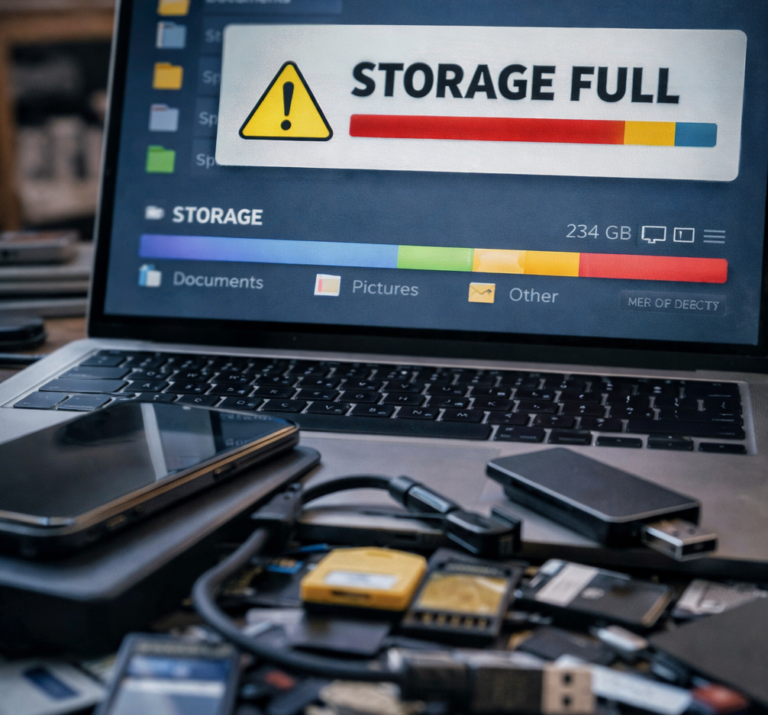
Step 2 — Free Up Storage Space Before It Chokes Performance
Storage is not just a place where files sit passively. When a phone gets too full, the operating system has less room to breathe. Temporary files, cached content, app updates, photo processing, and background system tasks all become harder to manage efficiently. That is when opening apps slows down, camera response lags, and system fluidity drops.
Here is the practical rule many users ignore: a phone becomes much less comfortable when storage is pushed too close to the limit. If you are above roughly 80% usage, performance often starts feeling heavier. Above that, the phone begins losing flexibility in how it manages internal tasks.
What to delete first
- Large videos you no longer need
- Duplicate photos and screenshots
- Downloaded files you forgot about
- Offline media from streaming apps
- Apps you have not used in months
- Heavy chat media in messaging apps
The goal is not obsessive minimalism. The goal is to give the system margin. A phone with breathing room behaves differently from a phone pushed to the edge of its storage capacity.
Step 3 — Reduce Background App Pressure and Silent RAM Drain
One of the biggest causes of a slow phone is not what you are actively using. It is what continues running after you stop looking at it. Background apps sync data, refresh feeds, check locations, preload content, send notifications, track activity, and quietly compete for memory and processor time.
This is where performance becomes deceptive. You may think one social app is innocent because it is closed on screen, while in reality multiple apps are still active behind the scenes. Together they create enough pressure to make everyday tasks feel heavy.
Not every background app is harmful, but too many of them together reduce responsiveness. Messaging apps and essential services can stay. The problem is the pile of shopping apps, video apps, casual games, utility apps, and social tools all asking for attention at once.
Action: review background activity settings and restrict non-essential apps from running freely.
On Android, you can often limit background battery usage or background data. On iPhone, you can reduce background app refresh for apps that do not need constant updating. The effect is usually not dramatic in one second, but it noticeably reduces system pressure across the day.
Step 4 — Clear Cache and Remove Digital Clutter, Not Just Apps
Many users understand that too many apps can slow a phone, but they forget that individual apps also accumulate weight over time. Browsers build up cached pages. Social apps collect media. Streaming apps store thumbnails and temporary content. Shopping apps cache product images. Messaging apps quietly hoard documents, stickers, videos, and downloaded previews.
Cache is not inherently bad. In fact, it is designed to make things faster by saving reusable data. But when cache grows excessively, becomes corrupted, or piles up across many large apps at once, it can contribute to overall slowness and storage strain.
Best places to check
- Browser cache
- Social media apps
- Messaging apps with heavy media
- Video streaming apps
- Map apps with downloaded data
The goal is not to wipe everything obsessively every day. It is to remove stale weight where it matters. A phone often feels faster not because you found a secret setting, but because you removed the silent debris slowing ordinary behavior.
Step 5 — Control Heat, Visual Effects, and the Hidden Cost of “Smooth” Design
A phone that gets warm often gets slower. This is not accidental. Modern devices reduce performance when temperatures rise in order to protect internal components. This is called thermal throttling. It means the phone intentionally slows itself down to stay safe.
This is why a phone may feel quick when first opened, then become laggy after ten minutes of gaming, video editing, camera use, GPS navigation, or charging under heavy use. The slowdown is not always a permanent weakness. It is sometimes a heat response.
Brightness at maximum, long gaming sessions, constant charging while using the phone, and heavy animations all increase strain. Even beautiful interface effects have a cost on lower-end or older hardware.
Action: remove the case temporarily if the phone is hot, reduce brightness, stop heavy apps, and reduce animations where possible.
This does not mean your phone should look ugly. It means performance and visual polish are always negotiating. On devices already under pressure, reducing unnecessary interface motion can make the phone feel more immediate.
Step 6 — Update the System and the Apps That Matter Most
Outdated software can absolutely affect performance. System updates often fix memory leaks, improve animation behavior, patch app compatibility issues, and solve bugs that quietly drag the phone down. The same is true for certain apps. A badly optimized app version can make a device feel worse than it should.
At the same time, updates are not magic. They do not turn a weak phone into a flagship. But when slowness is linked to software instability or unfinished optimization, updates can remove friction that users wrongly blame on age.
What to update first
- The operating system
- Your main browser
- Your keyboard app
- Large social or video apps
- System service apps from the device manufacturer
Here is what most people miss: if your phone became slow after an update, the answer is not always to fear updates forever. Sometimes the real fix is the next patch that corrects the previous bug.
Step 7 — Know When the Slowdown Is No Longer Just Congestion
Not every slow phone can be fully restored by cleaning up apps and storage. Sometimes the slowdown points to a deeper reality: aging hardware, degraded battery behavior, chronic thermal stress, or software demands that now exceed what the device handles comfortably.
This does not mean the phone is useless. It means your expectations need to become more precise. A device may still perform well for messaging, calls, reading, maps, and light social use while struggling with gaming, advanced camera processing, or multitasking between large modern apps.
Signs the slowdown may be deeper
- The phone remains sluggish even after restart and cleanup
- Storage is free, but lag persists everywhere
- The device overheats during basic tasks
- Apps crash more often than before
- Battery drains abnormally while performance drops
- The phone struggles with the newest system version consistently
At that stage, the question shifts. It is no longer only “How do I make this phone faster today?” It becomes “What level of performance is realistic for this hardware now?” That is an uncomfortable question, but it is more honest than endless fake optimization.
Repair Reality
The best optimization advice respects limits. Good maintenance can recover lost responsiveness. It cannot erase every effect of age, heat history, weak hardware, or poor software support forever.
Quick Performance Diagnosis Table
| What You Notice | Most Likely Cause | Best First Action |
|---|---|---|
| Apps open slowly | Storage pressure or heavy app clutter | Free storage and remove unused apps |
| Phone feels hot and laggy | Thermal throttling | Cool the device and stop heavy tasks |
| Keyboard appears late | Memory pressure or overloaded system | Restart and reduce background app activity |
| Scrolling stutters in many apps | Background load, heat, or software strain | Restart, update, and reduce active processes |
| Phone freezes randomly | Low storage or unstable app/system behavior | Clear space and check problematic apps |
| Still slow after cleanup | Deeper hardware or age-related limitation | Adjust expectations or consider device replacement timeline |
The Biggest Mistakes People Make When Trying to Speed Up a Phone
Installing “cleaner” apps to clean an already overloaded phone
This is one of the most common traps. Many of these apps add more load, more notifications, more storage use, and more background activity while pretending to solve the problem.
Ignoring storage until it is almost full
People often start managing storage only when they cannot take photos or install updates. By then, performance may have been suffering for weeks.
Blaming the battery for every slowdown
Battery health matters, but not every performance issue begins there. Storage, heat, software strain, and app behavior are often more immediate causes.
Keeping dozens of apps “just in case”
Every app adds potential clutter, background activity, cached data, and update overhead. Digital minimalism is not aesthetic here. It is performance hygiene.
Using the phone heavily while charging
This raises temperature, increases system strain, and can make the device feel slower at the exact moment the user expects it to recover.
What Most People Miss About Phone Speed
A phone does not only slow down because its processor becomes “weak.” It slows down because modern usage is layered. Every app wants attention. Every service wants background access. Every feed auto-refreshes. Every cloud tool syncs. Every camera feature, AI filter, backup process, and notification engine competes silently for the same shared resources.
That is why the feeling of speed is so fragile. A phone can score decently on paper yet feel slow in real life if the daily environment around it is too crowded. In that sense, phone performance is ecological. It depends on how much noise exists inside the system.
The fastest phones are not always the newest. Often they are simply the ones under the least internal pressure.
Practical Takeaways: What To Do Right Now
- Restart the phone before trying anything more complicated.
- Free storage space if you are getting close to full capacity.
- Limit background activity for non-essential apps.
- Clear heavy cache from browsers, social apps, and media apps.
- Control overheating by reducing heavy usage and visual load.
- Update the system and the apps that matter most.
- Do not install extra cleaner apps unless you want more clutter.
- If performance remains poor after cleanup, consider deeper hardware limits.
Frequently Asked Questions
Why is my phone suddenly so slow?
Can full storage really slow down a phone?
Do cleaner apps really make phones faster?
Why does my phone get slower when it gets hot?
Should I clear cache regularly?
When does a slow phone mean I need a new one?
Internal Linking Opportunities for ByteFix Lab
These three articles connect naturally with this guide and strengthen your performance category:
A Deeper Truth: Why Phone Slowness Changes Behavior
A slow phone is not just a performance problem. It is also a behavioral one. The device becomes slightly more difficult to use, so the user adapts. They open fewer apps. They tolerate delay. They accept friction. They lower expectations. In that quiet adaptation, the technology begins shaping the person more than the person shapes the technology.
This is what makes performance decline interesting beyond repair culture. The issue is not only that phones become slower. It is that users normalize the slowdown and reorganize their habits around it. That normalization matters because digital tools are no longer occasional objects. They are the infrastructure of everyday life.
There is also a broader economic truth underneath this. Devices are sold through aspiration, but lived through accumulation. Every new feature, every app ecosystem, every convenience layer adds more weight to the same finite hardware. The user sees innovation. The system feels pressure.
In the end, the real question is not only “How do I speed up my phone?”
The deeper question is: how much of modern frustration comes not from broken technology, but from technology that is still working while quietly becoming heavier than we were taught to notice?