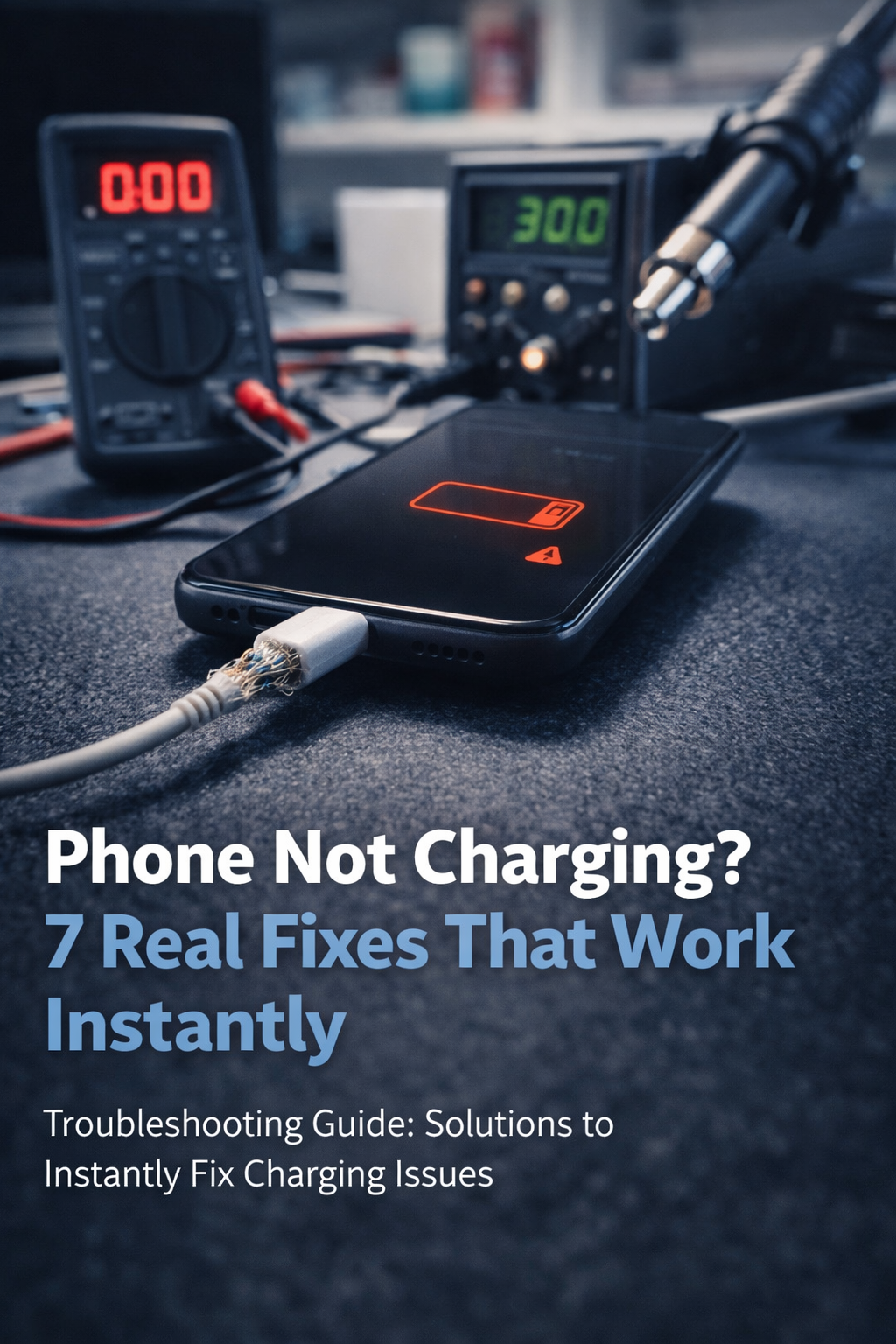

Phone Not Charging?
7 Real Fixes That Work Instantly
A dead phone can feel like a crisis. But most charging problems are smaller than they seem. This guide breaks down the real causes, the right fixes, the hidden mistakes, and the exact steps that can save your device before you waste money on unnecessary repairs.
Direct Answer — Featured Snippet
If your phone is not charging, the most common causes are a damaged cable, debris in the charging port, a faulty power adapter, overheating, moisture detection, software glitches, or battery wear. In most cases, you should test another cable, clean the port carefully, restart the phone, and let the device cool before assuming serious hardware damage.
Why This Problem Feels Bigger Than It Is
A phone that refuses to charge creates a very specific kind of panic. It is not the same as a slow app, a weak signal, or a frozen screen. Charging failure touches something more fundamental: survival. When your battery is low and your phone will not respond, every minute feels expensive. You start thinking about lost calls, unread messages, work interruptions, missing photos, navigation, banking apps, and all the quiet things modern life has compressed into a single device.
That fear often pushes people in the wrong direction. They assume the battery is dead forever. They order random accessories. They force the cable harder into the port. They shake the charger, bend the connector, or rush to a repair shop before checking the simplest causes. In other words, they react before they diagnose.
After comparing real charging problems across different devices, one truth keeps repeating: most charging failures are not catastrophic. They are usually caused by one weak point in a simple chain. The difficulty is not that the problem is always complex. The difficulty is that users rarely know where to start.
Repair Mindset
The smartest way to fix a phone that is not charging is to test the charging chain one piece at a time: outlet, adapter, cable, port, software, battery behavior, then internal hardware. Guessing creates stress. Method creates answers.
Search Intent Analysis: What People Really Want When They Search “Phone Not Charging”
At first glance, this looks like a simple informational search. A person wants to know why their phone is not charging. But the real intent is deeper than that. The user is not looking for theory. They are looking for a fast path from panic to certainty.
The hidden pain point is not just “my battery is low.” It is: “I need to know if this is serious, if I can fix it myself, and if I’m about to spend money.” That means the best article on this subject cannot be vague. It must combine quick answers, step-by-step testing, real-world symptoms, and clear boundaries between safe DIY troubleshooting and professional repair.
Many top-ranking pages fail here. They offer short lists without context. They say “try another charger” without explaining why that matters. They mention software bugs, but not how to recognize one. They tell people to clean the port, but not how to do it safely. They rarely distinguish between temporary charging interruption and long-term battery degradation.
A better guide has to do more. It must answer the immediate question, but it must also reduce uncertainty. That means helping the reader interpret symptoms, not just perform actions.
Why Most “Phone Not Charging” Articles Don’t Fully Solve the Problem
Most competing articles have three weaknesses. First, they are shallow. They list fixes without showing how one symptom leads logically to one cause. Second, they are outdated. Charging behavior has changed with newer safety systems, moisture detection, battery protection, and fast-charging standards. Third, they treat every phone the same, even though charging issues can come from very different layers of the device.
A modern smartphone does not charge through magic. It charges through a chain of components that must all work together: the wall outlet, the power adapter, the cable, the port, the charging controller, the software layer, and finally the battery itself. Failure in any one layer can interrupt the entire process.
Here is what most people miss: the phone is often not “refusing” to charge. It is protecting itself. It may stop charging because it is too hot. It may block charging because it detects moisture. It may charge slowly because the adapter cannot negotiate proper voltage. It may appear dead because the cable is delivering unstable power. The difference between malfunction and protection matters.
Understand the Charging Chain Before You Fix Anything
Before jumping into the seven fixes, it helps to understand the system you are testing. Charging is not one event. It is a sequence.
- Wall outlet: supplies base electrical power.
- Power adapter: converts that power into the format your phone needs.
- Cable: carries power from the adapter to the device.
- Charging port: creates the physical connection.
- Software and charging controller: decide whether charging should begin, continue, slow down, or stop.
- Battery: receives and stores the power.
If one link weakens, the entire experience changes. A dead outlet feels like a dead phone. A dirty port feels like a dead battery. A weak cable feels like a mysterious defect. A software glitch feels like hardware failure. This is why structured diagnosis matters.
7 Real Fixes That Work Instantly
The order below is intentional. Start with the easiest, safest, and most common causes. Only move deeper if the previous step does not solve the problem.
This is the number one hidden failure. Cables often break internally before they show visible damage. A cable may look normal, yet deliver unstable or insufficient power. If your phone charges only when the wire is bent a certain way, stops and starts randomly, or charges another device inconsistently, the cable is the prime suspect.
Cheap cables are especially risky. They may lack proper internal shielding, degrade quickly, or fail to support fast charging standards. Many users waste hours checking settings when the real problem is a cable that has quietly aged out.
What to do: test a certified or original cable immediately before trying anything complicated.
Dust, lint, pocket fibers, and tiny particles collect inside charging ports faster than most people realize. This is especially true if you keep your phone in jeans pockets, bags, dusty rooms, work vehicles, or jacket pockets during winter. Over time, the debris compresses at the base of the port and prevents the connector from fully seating.
The result is misleading. The cable looks connected, but electrical contact is incomplete. The phone may charge only at an angle, disconnect with the slightest movement, or not react at all.
Turn off the phone. Use a wooden toothpick or a soft non-metal cleaning tool. Work slowly. Do not scrape aggressively, and never use metal needles, pins, or anything conductive.
What to do: clean the port gently, then reconnect the cable and check whether it clicks in more firmly.
Users often test another cable but forget the adapter itself. That is a mistake. A weak, damaged, or low-quality wall adapter can cause no charging, slow charging, or intermittent charging. It may still power a small accessory while failing to deliver stable current to a phone.
Also test a different wall outlet. A loose extension strip, overloaded socket, worn plug, or poor contact point can create a fake device problem. If you normally charge through a laptop USB port, try a wall charger instead. Computer ports often deliver weaker power and make diagnosis harder.
What to do: switch the adapter and the outlet together so you are testing an entirely different power path.
Not every charging issue is physical. Software can interfere too. System glitches, failed updates, frozen power-management services, and background process conflicts sometimes prevent the phone from correctly detecting external power. This is more common after an update, after severe lag, or after a crash.
Restarting may feel too simple, but it matters because it resets temporary software states. If the phone is fully unresponsive, perform a forced restart using the correct key combination for your model.
What to do: restart before assuming your hardware is defective. A small software error can imitate a large repair problem.
Modern phones are designed to slow down, pause, or completely block charging when the temperature rises too high. That is not a defect. It is a safety response intended to protect the battery and internal circuits. If you were gaming, using GPS, recording video, charging under a blanket, or leaving the phone in direct sunlight, heat may be the real reason charging stopped.
Overheating can also explain “slow charging” that feels like no charging at all. The phone is still charging, but so slowly that the battery percentage barely moves.
What to do: remove the case, stop heavy apps, move the phone to a cool place, and wait before reconnecting power.
Even a phone that survived a splash may still refuse to charge for safety reasons. Many modern devices detect moisture in or around the port and stop charging automatically to avoid short circuits and corrosion. This can happen after rain, sweat, steam in a bathroom, humid environments, or small liquid contact you barely noticed.
The worst reaction is forcing the issue. Do not keep plugging and unplugging the charger. Do not use a hair dryer on high heat. Do not push foreign materials into the port. Let the device dry naturally in a well-ventilated space.
What to do: disconnect power, dry the phone patiently, and wait until any warning disappears before retesting.
If nothing above works, the problem may be deeper. Batteries degrade with age. Charging ports wear out. Internal charging controllers can fail. The signs are usually cumulative rather than sudden: the phone dies faster than before, percentage jumps erratically, charging becomes unreliable over weeks, or the connector feels mechanically loose even after cleaning.
This is the point where professional inspection becomes reasonable. But even here, your earlier troubleshooting still matters. When you already ruled out the cable, adapter, debris, heat, and software, you arrive at repair with evidence instead of confusion.
What to do: if all external causes are eliminated, get the port, battery, or charging circuit checked professionally.
Quick Comparison Table: Symptom, Likely Cause, and Best Fix
| What You Notice | Most Likely Cause | Best First Action |
|---|---|---|
| No charging icon at all | Dead cable or weak adapter | Test another cable and charger |
| Phone charges only at an angle | Dirty or worn charging port | Clean the port carefully |
| Charging starts, then stops | Loose connection or overheating | Cool the phone and retest with another cable |
| Very slow charging | Low-quality charger, background load, heat | Use a stronger certified adapter and close heavy apps |
| Moisture warning | Water or humidity detected | Stop charging and dry the device fully |
| Phone powers off even when plugged in | Battery degradation or internal fault | Rule out accessories, then inspect battery health |
The Biggest Mistakes People Make When Their Phone Won’t Charge
Some charging problems are caused by wear. Others are made worse by panic. There are a few recurring mistakes that turn a small problem into an expensive one.
Forcing the cable into the port
If the cable does not sit properly, many users push harder. That can damage the connector or bend fragile internal contact points. If a port feels blocked, assume dirt first, not resistance.
Using metal tools to clean the port
This is one of the most dangerous DIY habits. Metal can scratch contacts or create a short. A cleaning step meant to save your phone can become the reason it needs repair.
Charging while gaming or using heavy apps
The phone is trying to fill the battery while the device is rapidly consuming and generating heat. The result is painfully slow charging and temperature stress that users misread as failure.
Buying random cheap accessories online
Low-cost chargers and cables often promise speed but deliver instability. Poor accessories can damage the charging experience gradually, and in some cases they can damage the device itself.
Ignoring earlier warning signs
Charging problems rarely appear from nowhere. Many devices give quiet warnings first: charging only at a certain angle, the cable slipping out more easily, slower charging than usual, or rising heat. When those signs are ignored, the final failure feels sudden even though the decline was already visible.
What Most People Miss About Charging Ports
Charging ports are small, but they absorb a surprising amount of daily stress. Every connection creates micro-friction. Every rushed plug-in adds wear. Every dusty pocket adds contamination. People treat the port as passive, but it is one of the most physically stressed points on the entire device.
There is also a psychological blind spot. People assume a charging port is either “working” or “broken.” In reality, ports decline gradually. The first stage is subtle: a softer fit, slower recognition, occasional disconnections. The second stage is behavioral: users begin adjusting the cable angle without realizing it. The third stage is failure.
This matters because many charging issues live in that middle zone. The port is not fully dead, but it is no longer reliably healthy. Cleaning can solve it. Sometimes replacing the cable solves it. Sometimes it is a wear issue that only becomes obvious once the easy fixes fail.
Advanced Diagnosis: When the Simple Fixes Don’t Work
If you already tested a different cable, adapter, outlet, cleaned the port, restarted the phone, checked for moisture, and ruled out overheating, you are now dealing with a higher-level problem. This does not automatically mean disaster. It means the issue has moved from external causes toward internal ones.
Possible internal causes
- Worn charging port with damaged internal pins
- Battery that has degraded past reliable charging behavior
- Charging daughterboard issue in some phones
- Power management IC or charging controller fault
- Motherboard damage after drop, liquid exposure, or unstable power
This is where good troubleshooting saves money. If you walk into a repair situation already knowing that multiple chargers and cables failed, the port is clean, the phone is not overheating, and the behavior is consistent, you make diagnosis faster and harder to exaggerate. Evidence protects you.
Real-World Behavior Patterns Behind “Phone Not Charging”
One of the most useful ways to understand charging issues is to notice when they happen. Context reveals cause.
If it happened suddenly after travel
Pocket lint or dust inside the port becomes more likely. Travel bags, airport movement, jeans pockets, and temporary chargers create ideal conditions for accessory-related issues.
If it happened after an update
Software becomes a stronger suspect. Restarting, checking charging settings, and updating fully may matter more than replacing hardware immediately.
If it happens mainly while using the phone
Heat and high power consumption are likely involved. What looks like no charging may actually be the phone barely compensating for intense background use.
If it became gradually worse over weeks
Port wear, cable aging, or battery decline are more probable than a sudden chip failure. Gradual worsening usually points to cumulative wear, not instant damage.
If it started after moisture or cleaning liquid exposure
Even tiny amounts of moisture can trigger charging protection. This is especially common with steam, bathroom humidity, accidental splashes, or aggressive cleaning sprays.
Practical Takeaways: What to Do Right Now
- Start with the cable before blaming the battery.
- Inspect and clean the charging port carefully, never aggressively.
- Use another adapter and outlet to test the full power path.
- Restart the phone to eliminate temporary software confusion.
- Let the device cool down before charging if it feels warm.
- Take moisture warnings seriously and do not force charging.
- If nothing changes after structured testing, investigate battery or port wear.
Frequently Asked Questions
Why is my phone plugged in but not charging?
How do I know if my charging cable is bad?
Can dust in the charging port really stop a phone from charging?
Why does my phone charge slowly but not normally?
Should I use a metal pin to clean the charging port?
Can a software bug stop my phone from charging?
When should I stop troubleshooting and get repair help?
Internal Linking Opportunities for ByteFix Lab
These are three excellent internal articles to connect with this guide and strengthen your site structure:
A Deeper Truth: Why Small Charging Failures Matter More Than They Seem
A phone that stops charging is not just a technical inconvenience. It is also a glimpse into how modern technology is built, sold, and normalized. Devices are marketed as seamless, intelligent, and essential. Yet many of their most important physical points — cables, ports, batteries, connectors — remain fragile, stressed, and quietly disposable.
That fragility shapes behavior. Users adapt. They learn workarounds. They wiggle cables, tolerate slow charging, keep power banks everywhere, and treat minor failure as normal life rather than a design problem worth questioning. In that sense, the charging issue is bigger than charging. It reveals how people slowly reorganize themselves around the limitations of the objects they depend on.
There is also a power dimension here. The more dependent daily life becomes on one device, the more every small failure gains emotional weight. A weak battery, a worn port, a bad cable — these are tiny failures with disproportionate influence because the device now holds communication, labor, movement, entertainment, memory, and identity in one place.
The smartest response is not panic. It is clarity. Understand the system. Recognize the symptoms. Repair what is repairable. Refuse the lazy assumption that every problem means total replacement.
In the end, the real question is not only “Why is my phone not charging?”
The deeper question is: how much of modern life have we tied to tools that fail in silence, and how often do we mistake convenience for resilience?