
Laptop Running Slow?
10 Proven Ways to Speed It Up
A slow laptop does more than waste time. It interrupts thought, breaks concentration, and turns simple work into friction. The real problem is not always age. In many cases, the machine is still capable — it is simply overloaded, cluttered, or forced to work under the wrong conditions. This guide helps you separate normal slowdown from fixable performance loss, and shows you what actually makes a difference.

Direct Answer — Featured Snippet
If your laptop is running slow, the most common causes are too many startup programs, low free storage, insufficient RAM, overheating, background software load, malware, or an outdated hard drive. The fastest improvements usually come from disabling unnecessary startup apps, freeing storage, reducing background processes, scanning for malware, updating the system, and upgrading to an SSD if the laptop still uses a traditional hard drive.
Why a Slow Laptop Feels Like It Is Fighting You
A slow laptop changes the mood of work. You click once, then wait. You open a browser tab, then pause. You launch a file, then watch the cursor hesitate. The problem is not always dramatic enough to count as “broken,” but it becomes serious because it damages rhythm. And rhythm matters more than people admit. Productivity is often less about raw effort than uninterrupted flow. A slow laptop breaks that flow constantly.
That is why performance decline feels personal. The machine that once supported your work begins resisting it. Tasks stretch longer than they should. Multitasking becomes risky. Video calls stutter. Fans get louder. Opening several browser tabs feels like an act of aggression against your own device. Over time, the frustration becomes internalized. People stop trusting the laptop. They lower expectations. They do less at once. They reorganize around the weakness.
But here is the important distinction: a slow laptop is not always a dying laptop. Many systems feel “old” not because they are beyond help, but because years of software accumulation, storage pressure, startup clutter, overheating, and outdated components have slowly buried the hardware’s real potential.
Core Insight
A laptop rarely becomes slow for one magical reason. Slowness is usually the visible result of multiple small burdens stacking together over time.
What People Really Want When They Search “Laptop Running Slow”
On the surface, this is a troubleshooting query. But the real search intent is broader. Users are asking: Can I fix this without buying a new laptop? Is the problem hardware or software? What should I do first? And which fixes actually matter instead of wasting time?
That is why shallow articles on this topic often disappoint. They throw together random advice without hierarchy. They say “clear temp files,” “disable effects,” “scan for viruses,” “buy more RAM,” “upgrade the disk” — but they fail to explain which fixes produce the biggest gains, which symptoms point to which cause, and how to tell whether the laptop is congested, overheating, or simply limited by old hardware.
A useful guide must do more than offer tips. It must create an order. Start with the easiest, highest-impact software fixes. Then evaluate load, heat, storage, startup behavior, and outdated hardware. That sequence matters because a laptop can feel slow for very different reasons, and the right fix depends on what kind of slowness you are actually seeing.
Before You Speed It Up, Define What “Slow” Means on Your Laptop
Not all sluggish laptops behave the same way. One machine takes forever to boot. Another boots normally but freezes when opening apps. Another becomes noisy and slow after twenty minutes. Another is fine for typing, but collapses under browser tabs. These are different symptoms, and they often point to different bottlenecks.
- Slow startup: often linked to too many startup programs or a mechanical hard drive.
- Lag during multitasking: often linked to low RAM or excessive background processes.
- Slow file opening: often linked to storage issues or a failing/old drive.
- Laptop gets hot and slow: often linked to dust, thermal stress, or cooling problems.
- Browser slows everything down: often linked to too many tabs, extensions, and memory pressure.
- General system heaviness: often means several moderate problems are combining.
That distinction is essential. Performance is not one metric. It is an ecosystem of memory, storage speed, system cleanliness, heat management, and software behavior. Once you identify what kind of slow you are dealing with, the fixes become much more rational.
Table of Contents
- Fix 1 — Disable startup programs
- Fix 2 — Free up storage space
- Fix 3 — Upgrade from HDD to SSD
- Fix 4 — Add more RAM
- Fix 5 — Reduce background software load
- Fix 6 — Scan for malware and junk software
- Fix 7 — Update Windows and essential drivers
- Fix 8 — Reduce browser and extension overload
- Fix 9 — Manage heat and airflow
- Fix 10 — Restart smartly and maintain regularly
- FAQ
Why Most Laptop Speed Advice Misses the Biggest Bottlenecks
A lot of generic optimization advice treats every laptop the same. That is the first mistake. A 5-year-old laptop with an HDD has a very different bottleneck from a newer ultrabook with low RAM. A clean business laptop behaves differently from a gaming laptop clogged with launchers, overlays, and hot background tools. And a student laptop used with 40 Chrome tabs faces different stress than a lightly used home machine.
Here is what most people miss: perceived laptop speed is shaped less by processor marketing and more by friction points. A decent CPU can still feel terrible if the laptop boots from an HDD, runs 20 startup apps, stores almost no free space, overheats under light load, and manages browser memory poorly. In other words, the machine may be “powerful enough” and still feel slow in daily life.
The right approach is not magical acceleration. It is removing the biggest sources of friction in the correct order.
Fix 1 — Disable Startup Programs That Waste Speed Before You Even Begin
Many slow laptops reveal their problem the moment you turn them on. Boot takes too long. The desktop appears, but it stays half-frozen. The taskbar hesitates. The fan starts early. The machine feels busy before you have even opened anything. That is often a startup problem.
Many programs set themselves to launch automatically. Cloud tools, messaging apps, update managers, game platforms, printer utilities, audio tools, antivirus suites, browser helpers, and manufacturer services all compete for attention during startup. Each one may look harmless alone. Together, they create a traffic jam.
The best startup list is not empty, but it is selective. Essential security software and a few core tools may stay. Everything else should justify its presence. If you do not need an app the second the laptop boots, it should not start automatically.
Action: open Task Manager or system startup settings and disable anything non-essential.
Fix 2 — Free Up Storage Space and Give the System Room to Breathe
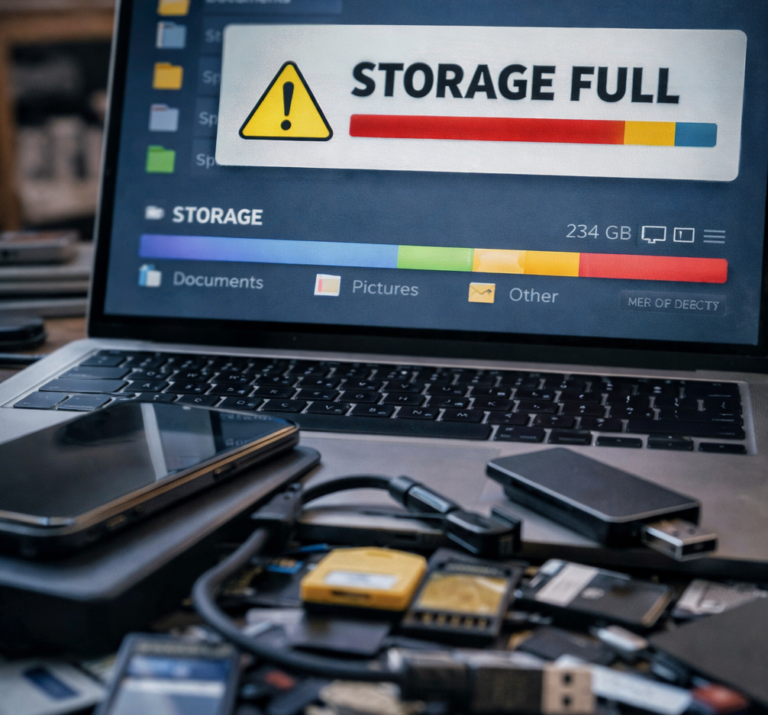
A laptop with almost no free storage becomes heavy in subtle ways. Updates struggle. Temporary files pile up. App installations drag. Browsers cache more aggressively than the disk can handle. File search slows. Even everyday tasks begin feeling sticky.
Storage is not only a container. It is working space. The operating system needs room for temporary operations, paging, updates, decompression, caching, and normal background maintenance. When free space disappears, flexibility disappears with it.
What to remove first
- Large videos and duplicate downloads
- Unused software and games
- Old installers and zip files
- Temporary files and recycle bin contents
- Desktop clutter and forgotten folders
- Offline media from streaming platforms
One common mistake is focusing only on the Downloads folder while ignoring enormous hidden storage use from apps, launchers, and media libraries. The point is not simply deleting random things. It is creating margin. A laptop under constant storage pressure cannot behave elegantly.
Fix 3 — Upgrade from HDD to SSD if You Still Use a Hard Drive
This is often the single biggest speed upgrade a slow laptop can receive. If your laptop still runs on a mechanical hard drive, no amount of software optimization will fully hide that bottleneck. An HDD introduces slowness at the level of basic system behavior: booting, opening apps, loading files, switching tasks, installing updates, and waking from sleep.
This is where many users misunderstand performance. They think the processor is the main story. Often it is not. A modest laptop with an SSD can feel better in everyday use than a theoretically stronger laptop trapped behind an HDD.
SSDs reduce waiting time across the whole machine. They do not merely speed up one task. They change the feeling of the laptop. Boot becomes faster, apps respond sooner, file access improves, and the system stops feeling like it is constantly catching up with itself.
Action: if your laptop still uses an HDD, prioritize SSD upgrade before many smaller tweaks.
Why This Matters
An SSD upgrade does not just improve benchmarks. It changes the lived experience of the machine more than most software tweaks ever can.
Fix 4 — Add More RAM if Multitasking Feels Like a Struggle
Memory pressure has a very specific feel. The laptop opens one or two things fine, then begins hesitating. Switching between apps becomes clumsy. Browser tabs reload unexpectedly. Video calls degrade. Typing lags while multiple windows are open. The machine does not necessarily crash. It just loses grace under load.
If that sounds familiar, RAM may be your bottleneck. More memory allows the system to keep more active work ready at once instead of constantly shifting data back and forth under pressure.
Common signs of low RAM
- Browser becomes heavy with moderate tab use
- Apps reload when switching back
- Video meetings cause overall lag
- Multitasking feels worse than boot speed
- System responsiveness collapses when several tools are open
RAM does not fix every kind of slowness, but when it is the real bottleneck, the improvement is immediate and obvious. The laptop stops feeling nervous.
Fix 5 — Reduce Background Software Load and Hidden Resource Drains
A laptop can appear idle while doing a surprising amount of work. Sync tools upload files. Update managers scan in the background. Launcher software checks online services. Messaging apps stay active. Browser helpers run quietly. Manufacturer software reports system status. Cloud clients monitor folders constantly. Overlays, widgets, assistants, and utility software all add invisible pressure.
This is why some laptops feel slow even when “nothing is open.” A lot is open. You just are not looking at it directly.
Software should earn its place. If an app launches services, syncs in the background, adds tray icons, or keeps checking online activity without giving daily value, it is not neutral. It is part of the slowdown.
Action: review background apps, tray icons, and always-on software with a ruthless eye.
This is not about making the laptop empty. It is about reducing friction. A cleaner environment improves speed not through magic, but through less competition.
Fix 6 — Scan for Malware, Adware, and Junk Software You Never Truly Wanted
Sometimes a laptop is slow because it is not entirely yours anymore. Browser hijackers, aggressive bundled software, deceptive utilities, adware, and shady background tools can drag performance down while pretending to help. Not all malware looks dramatic. Some of it simply consumes resources, pushes ads, changes browser behavior, or spams startup with hidden tasks.
This matters especially on laptops that have installed lots of freeware, questionable download bundles, fake optimizer tools, or browser extensions with unclear value.
A proper malware scan does not just protect privacy. It can restore performance if the system has been quietly burdened by software that should never have been there in the first place.
Fix 7 — Update Windows, Drivers, and Core Software the Right Way
Outdated systems can absolutely contribute to slowness. Driver bugs, memory leaks, inefficient power behavior, poor hardware communication, and unresolved compatibility issues all add invisible friction. At the same time, updates are not automatically perfect. The goal is not blind updating. It is targeted stability.
Start with the operating system, chipset or core drivers if appropriate, graphics drivers when relevant, and essential system software. This is especially useful if the laptop became slower after long neglect or if performance problems appear connected to a recent instability.
One of the most common mistakes users make is ignoring updates for months, then blaming the laptop for behaviors partially caused by aging software layers interacting badly.
Fix 8 — Reduce Browser Overload and Extension Bloat
For many people, the browser is the computer. That means browser problems become laptop problems. Dozens of tabs, memory-heavy sites, video streaming, live documents, social feeds, dashboards, and poorly chosen extensions can create a level of strain that users misread as general laptop weakness.
Extensions are especially underestimated. Each one may look harmless. Together they can slow startup, increase memory use, interfere with page behavior, and reduce responsiveness across the browser.
What to cut first
- Unused extensions
- Duplicate productivity tools doing similar jobs
- Coupon, shopping, or aggressive “helper” plugins
- Excessive pinned tabs
- Browser windows you keep open out of habit, not need
When a laptop feels slow mainly during browsing, do not begin with the whole machine. Begin with the digital environment most responsible for the load.
Fix 9 — Manage Heat, Dust, and Airflow Before Thermal Throttling Takes Over
A hot laptop is often a slow laptop. When internal temperatures rise, the system may reduce performance to protect itself. This is thermal throttling, and it can make a perfectly decent laptop feel weak during work that once felt normal.
Heat problems are especially likely if the fan is loud, vents are dusty, the laptop is used on soft surfaces, or performance gets worse the longer the session continues. This kind of slowdown is different from storage pressure. It builds with time and temperature.
Clear vents, avoid using the laptop on beds or cushions, and consider cleaning internal dust if the machine is old and overheating regularly. Heat reduces performance even when every other optimization looks correct on paper.
Action: if the laptop gets slower as it gets hotter, temperature is part of the diagnosis.
Fix 10 — Restart Smartly and Build a Real Maintenance Habit
Restarts matter on laptops too. Systems that stay on for long periods can accumulate memory strain, stuck background states, and reduced responsiveness over time. Restarting is not a complete optimization strategy, but it is part of a healthy maintenance rhythm.
More importantly, speed is easier to preserve than to recover. A laptop maintained lightly and consistently behaves better than one that gets ignored until it becomes nearly unusable.
Simple maintenance habits that actually help
- Restart periodically instead of relying only on sleep
- Keep storage from reaching the danger zone
- Review startup apps every few months
- Remove software you no longer use
- Keep browser habits under control
- Watch for heat and fan behavior changes
The goal is not perfection. It is preventing accumulation from quietly turning a functional laptop into an irritating one.
Quick Performance Diagnosis Table
| What You Notice | Most Likely Cause | Best First Action |
|---|---|---|
| Very slow boot time | Too many startup apps or HDD | Clean startup and check drive type |
| Slow when multitasking | Low RAM or background load | Reduce background software and assess memory |
| Slow after 20–30 minutes | Heat and thermal throttling | Check cooling, dust, and airflow |
| Browser makes everything lag | Too many tabs or extensions | Reduce browser overload |
| System feels heavy overall | Storage pressure, clutter, junk software | Free storage and scan for unwanted software |
| Still slow after cleanup | Old hardware bottleneck | Consider SSD or RAM upgrade |
The Biggest Mistakes People Make When Trying to Speed Up a Laptop
Installing fake “optimizer” software
Many so-called booster tools create more background noise than they remove. They sell the feeling of maintenance while adding their own weight.
Ignoring the hard drive bottleneck
People often tweak settings for hours while still booting from an HDD. That is like cleaning windows on a car with a failing engine and expecting a smoother ride.
Keeping too many apps “just in case”
Unused software is not harmless. It often leaves services, update agents, and startup entries behind.
Blaming the CPU for everything
The processor is only one part of everyday performance. Storage speed, RAM, heat, startup clutter, and browser behavior often matter more in normal use.
Never cleaning the software environment
Digital clutter accumulates slowly. That is what makes it dangerous. People adapt to it until the slowdown becomes their new normal.
What Most People Miss About Laptop Speed
Laptop performance is not only a technical issue. It is a design issue, a behavior issue, and often an attention issue. Modern users ask one machine to be a workplace, media center, communication hub, editing station, research library, and entertainment platform at the same time. The laptop becomes slow not only because it is weak, but because it is asked to host too much digital life without enough discipline around that life.
This is why the same laptop can feel totally different in different hands. One user keeps it lean, restarts regularly, installs selectively, and maintains free storage. Another covers it in helpers, launchers, tabs, sync tools, and digital debris. The hardware may be identical. The experience is not.
Practical Takeaways: What To Do Right Now
- Disable non-essential startup apps first.
- Free enough storage to give the system breathing room.
- If you still use an HDD, prioritize an SSD upgrade.
- Add RAM if multitasking is the main pain point.
- Reduce always-on background software and tray clutter.
- Scan for malware and junk utilities.
- Update the operating system and important software layers.
- Cut browser tabs and unnecessary extensions.
- Take overheating seriously if speed drops over time.
- Maintain the laptop regularly instead of waiting for collapse.
Frequently Asked Questions
Why is my laptop so slow all of a sudden?
What upgrade makes the biggest speed difference?
How do I know if I need more RAM?
Can too many browser tabs really slow the whole laptop?
Does overheating make a laptop slower?
Should I use laptop cleaner or booster software?
When is it time to replace the laptop instead of optimizing it?
Internal Linking Opportunities for ByteFix Lab
These three articles connect naturally with this guide and strengthen your laptop performance cluster:
A Deeper Truth: Why Slow Computers Change the Way People Think
A slow laptop is not only a machine problem. It becomes a cognitive problem. Every delay interrupts mental flow. Every hesitation teaches the user to expect resistance. Over time, people think in smaller tasks, avoid opening one more tab, postpone one more action, and quietly adapt to lower performance as if it were a personal limitation rather than a technical one.
This is what makes performance decay more important than it appears. It does not merely waste minutes. It shapes behavior. The machine begins deciding what feels worth attempting. That is a subtle transfer of control — from the user’s intention to the device’s limits.
There is also a broader economic truth here. Modern devices are marketed as empowerment tools, but much of digital life is built on accumulation: more apps, more services, more layers, more integrations, more convenience. The result is not always freedom. Sometimes it is weight disguised as progress.
In the end, the real question is not only “How do I speed up my laptop?”
The deeper question is: how much of modern inefficiency comes from failing machines, and how much comes from the silent accumulation we were trained to call convenience?