

App Keeps Crashing?
6 Easy Fixes That Actually Work
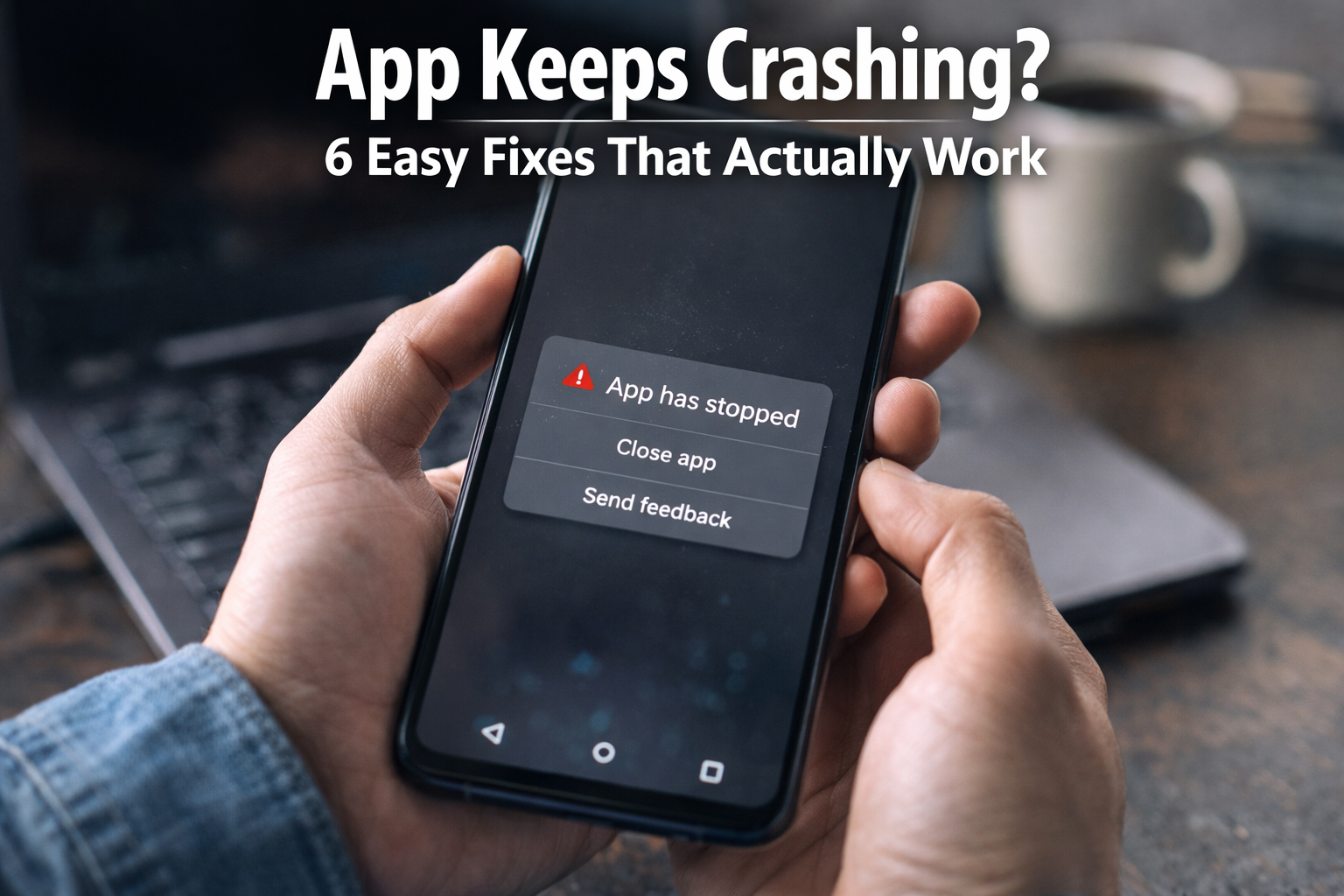
Few things are more irritating than tapping an app, watching it open for a second, and then seeing it disappear again. A crashing app feels unreliable in the most personal way because it interrupts whatever you were trying to do right at the moment you needed the device to behave. The good news is that most app crashes are not random, and they are rarely unfixable. They usually come from a short list of causes that can be tested in the right order.
Direct Answer — Featured Snippet
If an app keeps crashing, the most common causes are corrupted cache, outdated app versions, low storage, software conflicts, unstable updates, or device memory pressure. The fastest fixes are to restart the phone, clear the app cache or app data, update the app, free storage space, update the operating system, or reinstall the app if the problem persists.
Why App Crashes Feel More Personal Than Other Tech Problems
A phone slowing down is frustrating, but at least it still works. A charging issue gives you a visible hardware story. An app crash is different. It feels unpredictable. You tap once, and the system briefly promises function, then instantly takes it away. That pattern creates a very particular form of irritation because the failure happens at the point of intention.
You were about to send a message, open a bank account, check directions, upload a file, or edit a photo. Instead, the app vanishes. That makes crashes feel less like technical inconvenience and more like broken trust. The user is not asking for abstract performance. They are asking for continuity.
The good news is that most app crashes follow recognizable logic. Apps crash because something in the environment around them has become unstable: damaged temporary data, a bad update, not enough storage, memory pressure, software incompatibility, or a deeper device issue. Once you stop treating crashes as mysterious, they become easier to fix calmly.
Core Insight
Most crashing apps are not “broken forever.” They are failing because one layer of data, compatibility, or system pressure around them has gone wrong.
What People Really Mean When They Search “App Keeps Crashing”
On the surface, this is a technical troubleshooting query. In reality, the user is asking a more urgent set of questions: Is the app itself the problem or my phone? Can I fix this in minutes? Am I about to lose data? And why did this start now when the app worked yesterday?
That is why shallow guides fail. They often list generic fixes without explaining what those fixes actually target. They say “restart your phone” without explaining that restart can clear memory pressure and stuck system services. They say “clear cache” without explaining when cache is useful and when it becomes corrupted. They say “reinstall the app” without warning the user about account data or unsynced content.
A useful article has to do more than give instructions. It has to reduce uncertainty. The user does not only want an app to stop crashing. They want to understand why it started crashing in the first place, and how to prevent the same failure from returning next week.
Before You Fix Anything, Identify What Kind of Crash You’re Actually Seeing
Not all crashes are the same. One app may close instantly on launch. Another runs for five minutes, then crashes during one specific action. Another only crashes after an update. Another works on Wi-Fi but fails on mobile data. Another fails only when the phone is hot or storage is nearly full. These differences matter because they point toward different causes.
- Instant crash on launch: often linked to corrupted cache, damaged app data, or a bad update.
- Crash during one action: often linked to a specific feature conflict, permission issue, or unsupported file/process.
- Crash after update: often linked to unstable app version or OS compatibility issue.
- Crash when phone is under pressure: often linked to low memory, overheating, or low storage.
- Only one app crashes: usually an app-level issue.
- Several apps crash: more likely a system-level or device-wide issue.
This matters because a crashing app is not always just an app problem. Sometimes it is the first visible symptom of a crowded or unstable system.
Why Many “Fix App Crash” Articles Don’t Go Deep Enough
Most competing articles stop at the obvious surface level. They tell you to force close the app, clear cache, update it, or reinstall it. That advice is not wrong, but it is incomplete. It does not explain why crashes happen, which symptom points to which fix, or how device-wide stress can make one app appear guilty when the real problem lives elsewhere.
Here is what most people miss: an app does not run in isolation. It runs inside a phone that has limited storage, limited memory, temperature limits, system services, permissions, network rules, and software layers that all influence behavior. A crash is sometimes the app’s fault. Sometimes it is the environment around the app collapsing under pressure.
That is why the right strategy is not random trial and error. It is structured elimination.
Fix 1 — Restart the Phone Before You Touch the App
This is the simplest fix, and people often underestimate it because it sounds too basic. But a restart is powerful for a reason. It clears temporary memory pressure, ends stuck system services, refreshes background processes, and gives the app a cleaner system environment to launch in.
If the app started crashing suddenly after your phone had been running for a long time, after heavy multitasking, after an update, or while the device felt hot, restart becomes even more relevant. It is not just “turning it off and on again.” It is resetting temporary instability.
If the crash was caused by temporary system strain, memory pressure, or a stuck background state, a restart may solve it immediately. Even when it does not solve the issue completely, it gives you a cleaner baseline for the next steps.
Action: restart first so you do not waste time diagnosing a problem that was only temporary.
Fix 2 — Clear Cache and Temporary App Data
This is one of the most effective fixes because many app crashes are caused by damaged or overloaded temporary data. Apps store cache to load faster, remember sessions, save previews, and improve responsiveness. That is useful — until the stored data becomes corrupted, inconsistent, or too heavy.
A corrupted cache can make an app behave strangely: crashing on launch, failing to load pages, freezing on one screen, or looping between partial startup and shutdown. Clearing cache removes the unstable temporary layer without necessarily deleting your account or permanent content.
Cache is the safer first step because it removes temporary clutter without fully resetting the app. If cache clearing does not help, app data reset may work — but that is more aggressive and may log you out or remove unsynced local content.
Action: start with cache, then move to full app data reset only if the crash continues.
Fix 3 — Update the App and Check Whether the Latest Version Is the Problem
Outdated apps crash because they fall behind system compatibility. Updated apps crash because sometimes the update itself is unstable. That tension is what makes version-related crashes confusing. Users assume “newest” automatically means “best.” In reality, app stability depends on how well the current version fits your device, OS version, permissions, and environment.
If the app has not been updated for a while, installing the latest version is often wise. If the crashes started immediately after an update, the story changes. Then the update may be the reason the app became unstable.
Timing matters. If the app was fine until a recent update, check reviews or reports from other users. If it was old and inconsistent already, update first. The key is not blind trust in updates, but using time patterns as evidence.
Action: compare the crash timeline with recent app updates before deciding the next step.
This is especially important for finance apps, social apps, browsers, editors, and anything that depends heavily on OS permissions or cloud syncing.
Fix 4 — Free Storage and Reduce Memory Pressure Around the App
Sometimes the app is not the real problem. The phone is. A device with nearly full storage, too many background processes, or low available memory creates an unstable environment where apps become more likely to freeze, lag, or crash. This is especially true for social apps, camera apps, editing tools, and anything media-heavy.
Here is what many users miss: an app crash can be a system symptom. The app simply becomes the first part of the system to fail visibly.
- Check whether storage is nearly full
- Close unnecessary background apps
- Restart after heavy multitasking
- Stop using the app while the phone is overheating
- Make sure the device is not trying to update many things in the background
System Reality
A crashing app is sometimes the first visible warning that the phone is under too much pressure overall. Fixing the environment around the app can be more effective than attacking the app itself.
Fix 5 — Reinstall the App the Right Way
Reinstalling is powerful because it removes corrupted app packages, damaged local data, and broken internal states all at once. But it should not be the first move in every case. It is stronger than cache clearing and more disruptive if the app contains unsynced work, drafts, downloads, or local settings.
Still, when an app keeps crashing after cache clearing, restart, and update checks, reinstalling often solves the problem because it replaces the full app environment with a fresh copy.
Reinstalling is effective, but it is not neutral. Make sure your login details, drafts, saved files, or app-specific content are safe before you remove the app completely.
Action: confirm that important data is synced or recoverable before reinstalling.
Fix 6 — Update the Operating System and Check for Deeper Software Conflicts
If one app crashes, the problem may be app-level. If several apps crash, or if one app crashes repeatedly after all obvious fixes, the operating system may be part of the story. System bugs, outdated OS versions, unfinished patches, permission conflicts, or device-wide instability can all make apps behave unpredictably.
This is especially likely when crashes started after a system update, after installing many new apps, or when the device shows other strange behaviors too: lag, overheating, storage warnings, keyboard delay, or random freezes.
If the app is only one symptom of a broader unstable system, the real fix may live outside the app. Operating system updates and permission corrections can restore normal behavior when app-level fixes keep failing.
Action: if several apps behave badly, stop blaming one app and inspect the system as a whole.
If crashes continue after all of this, the device may be dealing with deeper pressure: low-quality storage conditions, severe overheating, buggy manufacturer software, or hardware instability affecting software behavior.
Quick Crash Diagnosis Table
| What You Notice | Most Likely Cause | Best First Action |
|---|---|---|
| App crashes instantly on launch | Corrupted cache or bad app data | Clear cache, then test again |
| App crashes after recent update | Unstable app version or compatibility problem | Check version timing and update notes |
| Several apps crash randomly | System-wide instability or device pressure | Restart and inspect storage, memory, and OS status |
| App crashes during one specific feature | Permission conflict or feature-level bug | Check permissions and app updates |
| Crashes happen when phone is hot | Thermal stress or memory pressure | Cool the device and reduce load |
| Nothing helps | Deeper app corruption or OS-level issue | Reinstall app and check operating system stability |
The Biggest Mistakes People Make When an App Keeps Crashing
Tapping the app repeatedly without changing anything
This creates frustration, not diagnosis. Repetition without structure rarely produces answers.
Clearing everything at once without understanding the cause
Sometimes users delete app data, remove the app, and lose useful settings when a simple restart or cache clear would have been enough.
Ignoring storage and memory pressure
Many app crashes are aggravated by a device that is already overloaded.
Assuming the app alone is guilty
If several apps are unstable, the real issue may be system-wide.
Trusting that every update is automatically stable
Updates solve many problems, but occasionally they introduce new ones too. Timing matters.
What Most People Miss About Crashing Apps
A crashing app is often the first place where digital strain becomes visible. People think of apps as isolated tools, but they are really small ecosystems running inside a larger one. They depend on device memory, storage, permissions, updates, temperature conditions, network behavior, and software compatibility. When one layer slips, the app is often the first actor to fail on stage.
That matters because app crashes are rarely just about inconvenience. They reveal how dependent modern life has become on software layers most users never see. An app feels like one icon. In reality, it is the visible surface of a much larger and more fragile structure.
Practical Takeaways: What To Do Right Now
- Restart the phone before doing anything more aggressive.
- Clear cache first, then app data only if needed.
- Check whether the crash started after an update.
- Free storage space and reduce background app pressure.
- Reinstall the app only after protecting important local data.
- If several apps are unstable, inspect the whole system.
- Pay attention to heat, memory pressure, and timing patterns.
- Use evidence, not panic, to decide your next step.
Frequently Asked Questions
Why does one app keep crashing while everything else works?
Will clearing cache delete my account or personal data?
Why did the app start crashing after an update?
Can low storage make apps crash?
Should I reinstall the app right away?
What if several apps keep crashing, not just one?
Can overheating cause app crashes?
Internal Linking Opportunities for ByteFix Lab
These three articles connect naturally with this guide and strengthen your Apps & Software Solutions cluster:
A Deeper Truth: Why Software Failure Feels So Immediate
Hardware usually warns us physically. It heats up, slows down, drains, weakens, or breaks visibly. Software fails differently. It disappears. One second the app exists, the next second it is gone. That vanishing act is what makes crashes feel so sharp. The promise of seamless technology collapses in an instant.
This is also why app crashes matter beyond inconvenience. They remind us that modern life depends on layers of invisible reliability. We trust apps with money, memory, maps, identity, communication, health, and work. Yet most of that trust rests on systems we do not understand unless they fail.
In that sense, a crashing app is not just bad software behavior. It is a glimpse into the fragility of digital dependence. The icon looks simple. The infrastructure beneath it is not.
In the end, the real question is not only “How do I stop this app from crashing?”
The deeper question is: how much of modern confidence depends on software that feels stable only until the moment it suddenly disappears?